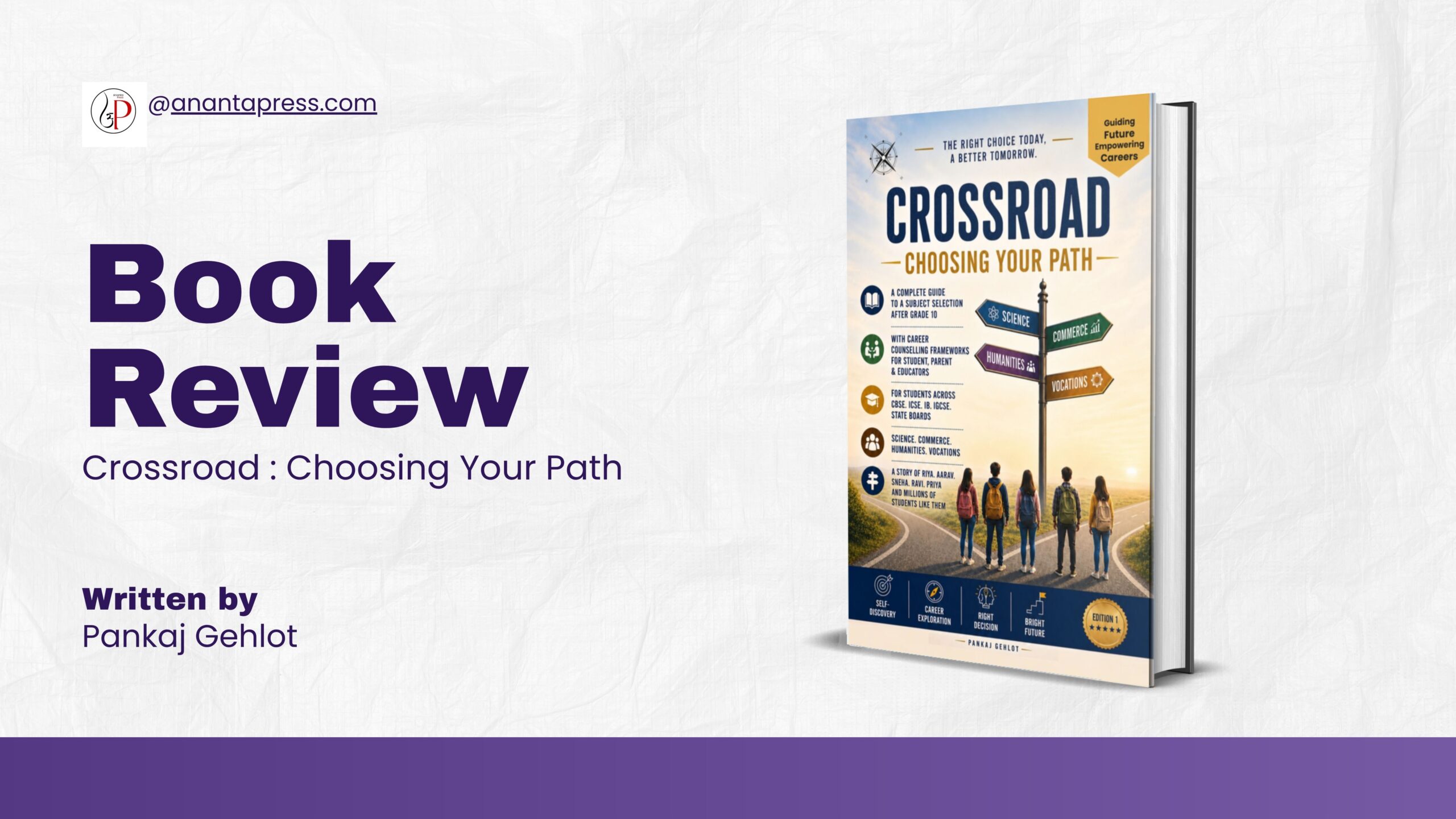
Choosing a subject stream after Grade 10 is one of the first big decisions in a student’s life. For many students, this decision comes with confusion, pressure, fear, and too many opinions from parents, relatives, teachers, friends, and society. In India, the question of choosing Science, Commerce, Humanities, or Vocational stream is not treated like a simple academic decision. It is often treated like a life-changing moment. This is exactly where Crossroad: Choosing Your Path by Pankaj Gehlot becomes an important and timely book.
This book is not just about choosing subjects. It is about understanding yourself before choosing your future. The author has written this book especially for students who are standing after Grade 10 and asking themselves, “What if I choose wrong?” That one question is very powerful because almost every student feels it at some point. The book does not ignore this fear. Instead, it accepts it and explains it with maturity and compassion.
One of the strongest points of this book is its emotional beginning. The book introduces students like Riya, Aarav, Sneha, Ravi, and Priya. These names are not just characters; they represent thousands of real students who are confused about their future. Riya’s story is especially relatable. She is good in mathematics, but she also loves storytelling and creativity. Her parents think Science is safe. Her teachers see potential in Commerce. Her friends are excited about Humanities. In the middle of all this, Riya is unable to hear her own voice. This situation is very common in Indian families.
The author understands that students do not make decisions in silence. They make decisions while carrying expectations. Parents want security for their child. Teachers give advice based on performance. Friends influence choices. Society gives labels to streams. Science is called prestigious. Commerce is called practical. Humanities is often misunderstood. Vocational education is sometimes ignored. The book carefully breaks these old ideas and shows that every stream has dignity, value, and scope when chosen for the right reason.
The language of the book is simple, but the message is deep. It does not sound like a boring career manual. It feels like a conversation between a mentor, a student, and a parent. This makes the book useful for different readers. A Grade 10 student can read it and feel understood. A parent can read it and realize how love sometimes becomes pressure. A teacher or counsellor can read it and use it as a structured resource while guiding students.
The chapters on parents are very important. Many parents do not intentionally pressurize their children. They only want a safe and successful future for them. But sometimes this love becomes direction, and the student feels trapped. The book explains that the role of parents is not to force a road but to sit with the child at the crossroads. Instead of saying, “You should choose Science,” parents can ask, “What excites you?” This small change in language can make a big difference in a child’s confidence.
Another valuable part of the book is its clear explanation of different streams. Science, Commerce, Humanities, and Vocational streams are discussed with honesty. The book does not promote one stream as better than another. It explains what each stream demands, what it builds, and where it can lead. This balanced approach is very necessary because many students choose streams based on myths. Some think Science is the only successful path. Some think Commerce is only for average students. Some think Humanities has no career scope. Some do not even consider Vocational options seriously. This book challenges these wrong beliefs.
The author also discusses career pathways in a practical way. This is very helpful because students often know the name of a stream but not the possibilities connected with it. For example, Science can lead to engineering, medicine, research, technology, biotechnology, and many other areas. Commerce can lead to finance, entrepreneurship, economics, management, and professional qualifications. Humanities can lead to law, psychology, journalism, civil services, design, education, social sciences, and many meaningful careers. Vocational streams can create strong skill-based futures in IT, hospitality, fashion, agriculture, media, and other practical fields.
The book also makes an important point: marks alone should not decide a stream. Many students with high marks are pushed into Science even when their interest is somewhere else. This creates stress later. At the same time, some students are stopped from choosing Science or Commerce because others assume they are not capable. Both situations are harmful. The right decision should come from a mix of interest, aptitude, personality, strengths, goals, and proper guidance.
One of the most meaningful ideas in the book is that confusion is not always bad. Sometimes confusion is the beginning of self-awareness. When a student is confused, it means they care about the decision. Instead of shutting down that confusion with pressure, adults should help the student explore it. This point makes the book emotionally mature.
The book also highlights the importance of career counselling and psychometric assessment. In many Indian schools, career guidance is still treated as optional. But the author strongly explains that structured guidance is not a luxury. It is a necessity. Students should not be expected to make such an important decision with incomplete information. A good counsellor can help students understand their strengths, interests, personality, and future options.
Another impressive thing about Crossroad is its storytelling style. The book does not only give advice; it shows situations. Through different students and family examples, the reader understands how decisions are actually made in real life. This storytelling makes the book more engaging and relatable. Students who may not like reading heavy guidance books may still connect with this one because it feels close to their own life.
For parents, this book can be eye-opening. Many parents think their child is confused because the child is immature. But this book shows that the child may be confused because too many voices are speaking at once. Parents may also realize that their own fear should not become the child’s burden. The best support is listening with patience.
For students, this book gives confidence. It tells them that they are not alone. Many students feel the same pressure, the same fear, and the same uncertainty. The book encourages them to ask honest questions: What do I enjoy? What am I good at? What kind of work can I see myself doing? Which subject gives me energy? Which path matches my personality?
Overall, Crossroad: Choosing Your Path is a very useful and meaningful book for Indian students and families. It is practical, emotional, simple, and relevant. It does not promise a magical answer, but it gives a clear map. And at this stage of life, a map is more useful than pressure.
This book should be read before filling the stream selection form. It should be read by students, parents, teachers, and counsellors. It reminds us that subject selection is not about choosing the most popular stream. It is about choosing the most honest one. A student’s future should not be built on fear, comparison, or social pressure. It should be built on clarity, self-awareness, guidance, and confidence.
Final Review:
Crossroad: Choosing Your Path is a must-read book for every Grade 9, Grade 10, and Grade 11 student. It is also highly recommended for parents who want to support their child’s future in the right way. The book gives clarity where there is confusion and confidence where there is fear.
Rating: 5/5