
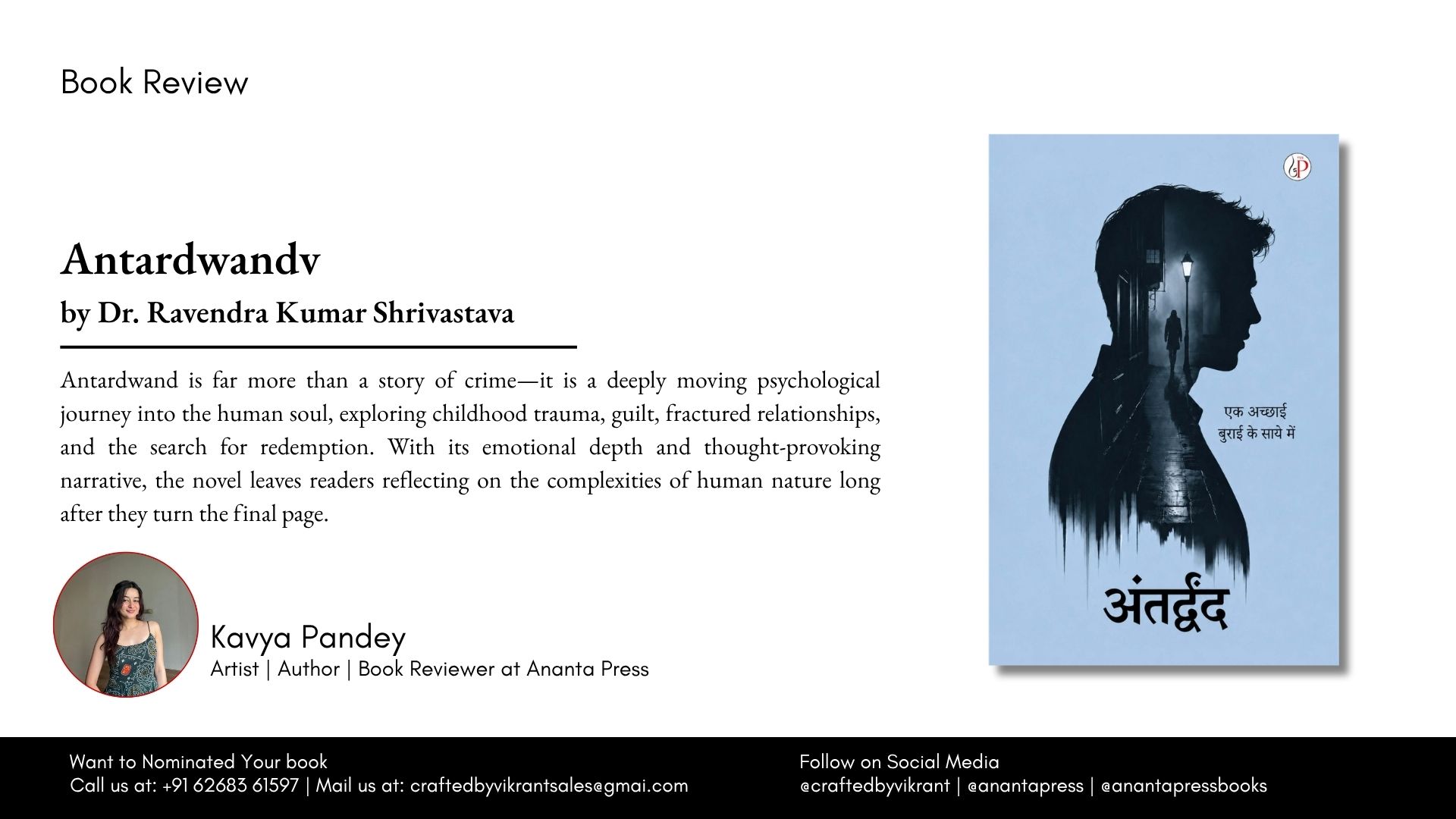
Dr. Ravendra Kumar Shrivastava’s Antardwand is a profound psychological novel that goes far beyond the boundaries of a conventional crime story. Rather than focusing on the act of murder itself, the novel explores the emotional and psychological journey that transforms an innocent child into a man condemned to death. It is a moving narrative about trauma, silence, guilt, loneliness, love, and the invisible battles that shape human lives. Rich in introspection and emotional depth, the novel compels readers to question whether people should be judged solely by their actions or by the experiences that created them.
The story revolves around Vijay, a man awaiting execution in a prison cell after being sentenced to death for murder. The novel opens on the final night before his execution, where silence, moonlight, and solitude become symbolic companions to his final journey. Instead of fearing death, Vijay turns inward, revisiting the memories that defined his existence. This unique narrative structure transforms the novel into a deeply reflective exploration of memory and human psychology. Every chapter uncovers another layer of his life, gradually revealing how a series of emotional wounds led him to the irreversible crime that changed everything.
One of the novel’s greatest strengths lies in its portrayal of childhood trauma. The defining moment of Vijay’s life occurs when, as a young boy, he is publicly beaten by a neighbor while his mother remains silent. That silence becomes far more painful than the physical violence itself. The author brilliantly demonstrates how emotional neglect can leave scars deeper than physical abuse. Rather than presenting this event merely as a childhood memory, Dr. Shrivastava portrays it as the psychological foundation upon which Vijay’s entire personality is built. It is this silent abandonment that shapes his distrust, emotional isolation, and inability to form healthy relationships throughout his life.
The psychological realism in the novel is remarkable. Vijay is neither portrayed as a hero nor as a villain. Instead, he is presented as an ordinary human being carrying extraordinary emotional burdens. Even after becoming wealthy and successful through relentless hard work, he remains emotionally empty. His professional achievements fail to heal the wounds of his childhood. This contrast between external success and internal suffering forms one of the novel’s most compelling themes. It reminds readers that financial prosperity can never substitute for emotional security, love, and acceptance.
The author masterfully illustrates how unresolved pain influences every aspect of Vijay’s life. His complicated relationship with his mother remains one of the novel’s emotional centers. Although he distances himself from her physically, he continues to support her financially without revealing his identity. This paradox beautifully captures the complexity of human emotions, where love and resentment coexist within the same heart. Rather than simplifying these emotions, the novel embraces their contradictions, making its characters feel deeply authentic.
Another powerful aspect of Antardwand is its exploration of guilt. Vijay’s remorse is not limited to the murder that sends him to prison. He carries guilt over numerous incidents throughout his life—a puppy’s accidental death, his inability to help a helpless woman at a railway station, and several moments where his compassion failed to translate into action. These seemingly small incidents reveal that beneath his hardened exterior remains an intensely sensitive individual. The novel argues that true guilt often arises not only from what we intentionally do but also from the kindness we fail to offer when it matters most.
The writing style deserves special appreciation. Dr. Shrivastava employs calm, reflective, and poetic language that perfectly complements the novel’s psychological depth. Descriptions of the prison cell, moonlight filtering through iron bars, empty corridors, and silent nights create a haunting atmosphere that mirrors Vijay’s emotional state. Rather than relying on dramatic twists or fast-paced action, the novel builds emotional intensity through introspection and memory. This literary approach allows readers to experience Vijay’s thoughts rather than merely observe his actions.
The novel also raises important philosophical and moral questions. It does not justify violence or attempt to excuse murder. Instead, it asks readers to examine the invisible chain of emotional events that often precedes destructive actions. Dr. Shrivastava challenges society to look beyond legal definitions of crime and consider the psychological realities that shape human behavior. While the law punishes the final act, the novel encourages readers to reflect on the years of neglect, loneliness, rejection, and emotional suffering that often remain unnoticed.
One of the book’s greatest achievements is its nuanced portrayal of human nature. Vijay cannot be categorized simply as good or evil. He is compassionate yet distrustful, generous yet emotionally distant, successful yet deeply lonely. This complexity reflects real life, where people are rarely defined by a single characteristic. The author reminds us that every individual carries invisible struggles, unresolved memories, and emotional contradictions that influence their choices. Such multidimensional characterization makes Vijay one of the most believable protagonists in contemporary psychological fiction.
The pacing of the novel is deliberate and contemplative. Readers expecting a traditional thriller may initially find it slow, but those willing to immerse themselves in its emotional landscape will discover an exceptionally rewarding experience. Each chapter gradually uncovers another piece of Vijay’s past, allowing readers to understand—not necessarily forgive—the choices that ultimately define his fate. The gradual revelation of memories creates emotional suspense that is more powerful than conventional plot-driven tension.
Another notable strength is the novel’s emotional honesty. The author avoids melodrama and sensationalism, choosing instead to present suffering with dignity and restraint. Moments of pain are neither exaggerated nor minimized. Whether describing childhood loneliness, adult isolation, or the quiet acceptance of impending death, the narrative remains sincere and deeply humane. This emotional authenticity enables readers to connect with Vijay despite his tragic mistakes.
The symbolism throughout the novel is equally impressive. The recurring image of moonlight entering the prison cell through iron bars reflects hope imprisoned by circumstances, while the silent prison itself becomes a metaphor for the emotional prisons people construct within themselves. Memory functions almost like another character, guiding Vijay through the final examination of his own life. These literary elements enrich the reading experience and elevate the novel beyond a simple psychological drama.
Antardwand also succeeds in presenting a universal message. Although Vijay’s story is unique, his emotional struggles resonate with anyone who has experienced rejection, loneliness, guilt, or unresolved relationships. The novel encourages readers to recognize the importance of empathy, communication, and emotional support. It reminds us that silence can sometimes inflict deeper wounds than words, and that unhealed childhood experiences often continue to shape adult lives in unexpected ways.
Ultimately, Antardwand is a thoughtful and emotionally powerful work that invites readers to look beneath the surface of human behavior. It neither romanticizes crime nor simplifies morality. Instead, it offers a compassionate exploration of the fragile human mind and the lasting consequences of emotional neglect. Dr. Ravendra Kumar Shrivastava demonstrates exceptional insight into human psychology, creating a narrative that remains both intellectually stimulating and emotionally moving.
In conclusion, Antardwand is an outstanding psychological novel that leaves a lasting impression long after the final page. Through Vijay’s tragic journey, the author explores the complexities of memory, trauma, love, guilt, forgiveness, and identity with remarkable sensitivity. It is a book that encourages introspection while challenging readers to rethink their understanding of justice and humanity. Highly recommended for readers who appreciate literary fiction, psychological drama, and character-driven storytelling, Antardwand stands as a compelling reminder that every human being carries an unseen story within—and sometimes, understanding that story is the first step toward understanding the person.