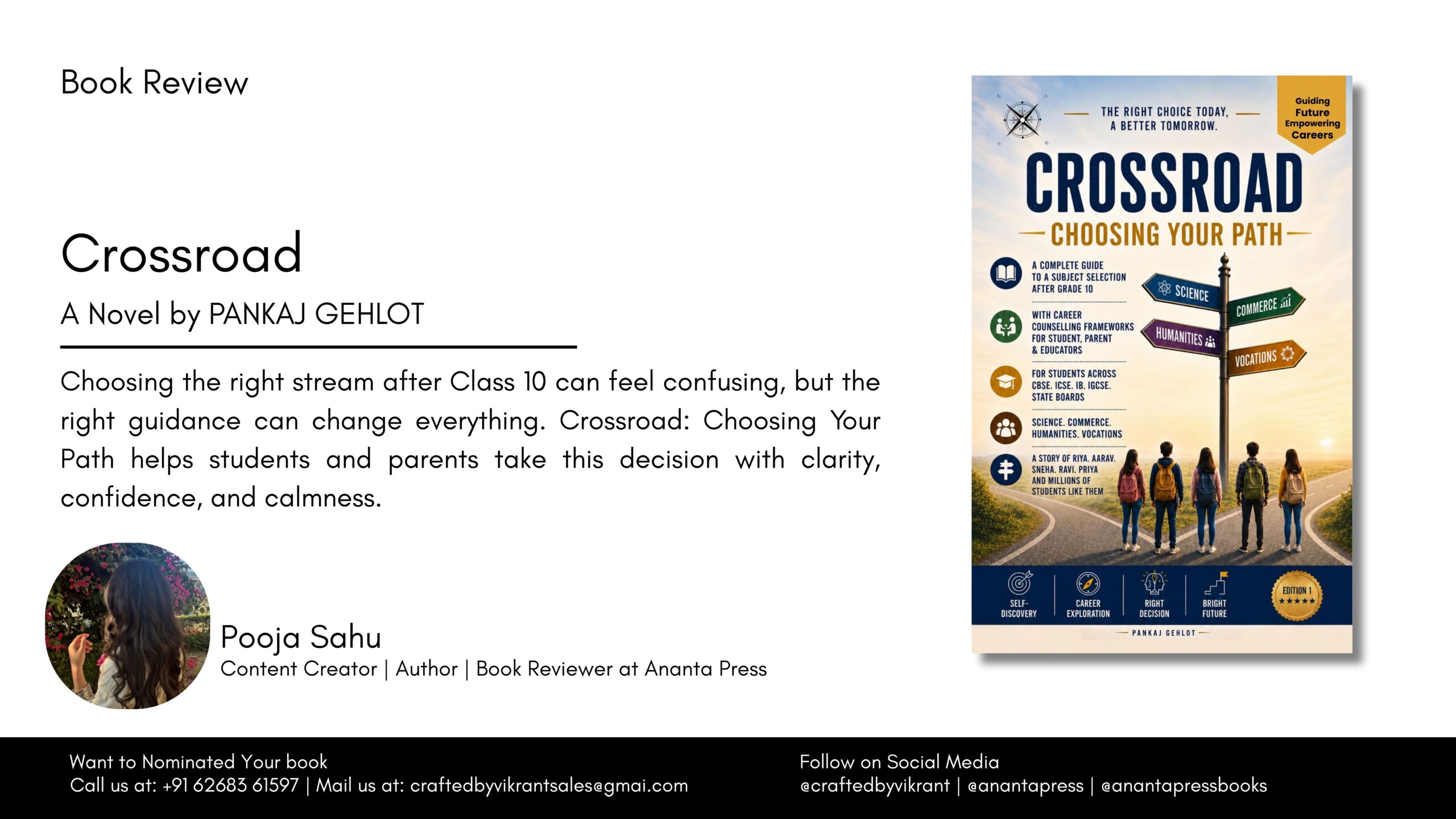
In every student’s school life, there comes one moment when the future suddenly starts feeling serious. For most Indian students, that moment comes after Grade 10. Until then, students mostly study common subjects. But after Grade 10, they are asked to choose a stream: Science, Commerce, Humanities, or Vocational. For adults, it may look like a normal academic process. But for a sixteen-year-old student, it can feel like standing at a very big crossroads. Crossroad: Choosing Your Path by Pankaj Gehlot understands this feeling very well.
This book is a complete guide for subject selection after Grade 10, but it is much more than a guide. It is a thoughtful book about students, parents, pressure, expectations, career dreams, fear of failure, and the need for honest guidance. The book speaks to the real Indian education environment where subject choices are often influenced by marks, family dreams, peer pressure, and social status.
The title Crossroad is perfect because the book is really about that one stage where students feel pulled in many directions. One road says Science is safe. Another road says Commerce is practical. Another road says Humanities is creative and meaningful. Another road says skills and vocational education can build a strong future. But the student standing in the middle often does not know which road truly belongs to them.
The author does not make the mistake of giving one fixed answer for everyone. This is one of the best qualities of the book. It does not say Science is best, Commerce is best, or Humanities is best. It says that the right path depends on the student. This approach is very important because every child has different strengths, interests, dreams, and personality.
The book begins with emotional stories, especially the story of Riya. She is a Grade 10 student who is good at mathematics but also loves creativity and storytelling. Her parents think about a secure future. Her teachers see her academic skills. Her friends influence her with their own choices. Riya’s confusion feels very real because many students go through the same thing. They are not confused because they are careless. They are confused because the decision matters.
One line of thought that runs beautifully through the book is that students need space to hear their own voice. In many families, students are asked what they want only after everyone else has already given their opinion. Parents, relatives, teachers, neighbours, and friends all speak. By the time the student tries to speak, their own voice becomes weak. This book asks adults to slow down and listen.
The chapter about parental expectations is especially powerful. In India, parents often connect stream selection with safety and respect. Many parents prefer Science because they believe it opens more doors. Some prefer Commerce because they see business and finance opportunities. Some worry about Humanities because society has created wrong ideas around it. The book explains that parents’ fears are understandable, but fear should not become pressure. Love should become support, not control.
This message is very useful for parents. A parent reading this book may realize that their child needs guidance, not command. The book shows that the best question a parent can ask is not, “Which stream will give you the highest salary?” but “What kind of work makes you feel alive?” This does not mean practical concerns should be ignored. It means practical planning should be combined with self-awareness.
The book is also strong because it breaks common myths. Many students still hear statements like “Only Science students are intelligent,” “Commerce is for average students,” “Arts has no scope,” or “Vocational stream is not respectable.” These statements are harmful and outdated. The book challenges such thinking and gives respect to every stream. This is one of the biggest contributions of the book.
Science is explained not only as a prestigious stream but as a path for students who enjoy logic, curiosity, problem-solving, and discipline. Commerce is presented as a strong stream for students interested in finance, business, economics, entrepreneurship, and systems. Humanities is shown as a serious and powerful stream for students interested in people, society, law, psychology, communication, public service, and creativity. Vocational education is discussed as a practical and valuable option for students who want skill-based careers.
The book also gives importance to career pathways. This is very helpful because many students choose a stream without understanding what comes after it. They may choose Science but not know the difference between PCM, PCB, and PCMB. They may choose Commerce but not know about professional qualifications, economics, finance, management, or entrepreneurship. They may choose Humanities but not understand its connection with law, psychology, media, civil services, design, and international careers. They may ignore Vocational streams without knowing the real opportunities in skill-based fields.
A good career decision is not only about the next two years. It is about the kind of skills the student will build. This book explains that every stream develops a different way of thinking. Science builds analytical thinking. Commerce builds understanding of systems and value. Humanities builds critical thinking, empathy, communication, and social understanding. Vocational streams build practical skills and employability. When students understand this, they can make a more informed decision.
Another major strength of the book is its discussion on career counselling. The author explains that students should not be left alone with such a serious decision. Career counselling, psychometric tools, and structured guidance can help students understand themselves better. In India, many families still think career counselling is needed only when a child is very confused. But this book shows that guidance is useful even for bright and confident students.
The book is also helpful for educators. Teachers often see students struggling with stream choices, but they may not always have a structured way to guide them. Crossroad can become a resource for schools, counsellors, and educators because it combines stories, explanations, reflection, and practical frameworks. It can be used for discussions with students and parents before stream selection.
The writing style of the book is simple and engaging. It is not written like a dry textbook. It has emotion, examples, and real-life situations. This makes it easy for students to connect with the content. The book also has a compassionate tone. It does not judge students for being confused. It does not blame parents for being worried. It simply tries to bring both sides into a better conversation.
One of the best messages of the book is that the right stream is not always the most prestigious one. The right stream is the one that matches the student’s strengths, interests, and future direction. This is a very important lesson. A student who chooses a stream honestly may work harder, learn better, and feel more confident. A student who chooses only because of pressure may struggle even if they are capable.
The book also reminds us that career decisions are not made in one day. They need reflection. Students should think about what subjects they enjoy, what problems they like solving, what kind of environment suits them, what careers interest them, and what kind of future they can imagine. Parents should support this reflection instead of rushing the decision.
For Indian families, this book can create better conversations at home. Many times, stream selection becomes an argument. The student feels misunderstood. The parent feels worried. The teacher feels responsible. This book can help everyone come to the same table with more clarity and less fear.
Crossroad: Choosing Your Path is especially useful now because career options are changing quickly. Today, success does not come from one fixed path only. Students can build futures in technology, business, law, design, healthcare, research, media, psychology, public policy, entrepreneurship, skill-based professions, and many other areas. Old labels are no longer enough. Students need updated guidance and flexible thinking.
Overall, this book is a meaningful contribution to student guidance. It is practical, emotional, balanced, and very relevant for today’s education system. It respects students and also respects parents. It does not create fear. It creates clarity.
Final Review:
Crossroad: Choosing Your Path by Pankaj Gehlot is a must-read for students after Grade 10 and their families. It helps students understand different streams, break myths, handle pressure, and make a thoughtful decision. It is also a strong resource for teachers, counsellors, and schools.
This book should be kept in every school library and recommended to every family before subject selection. It can help students choose not out of fear, but with confidence and self-understanding.
Rating: 5/5