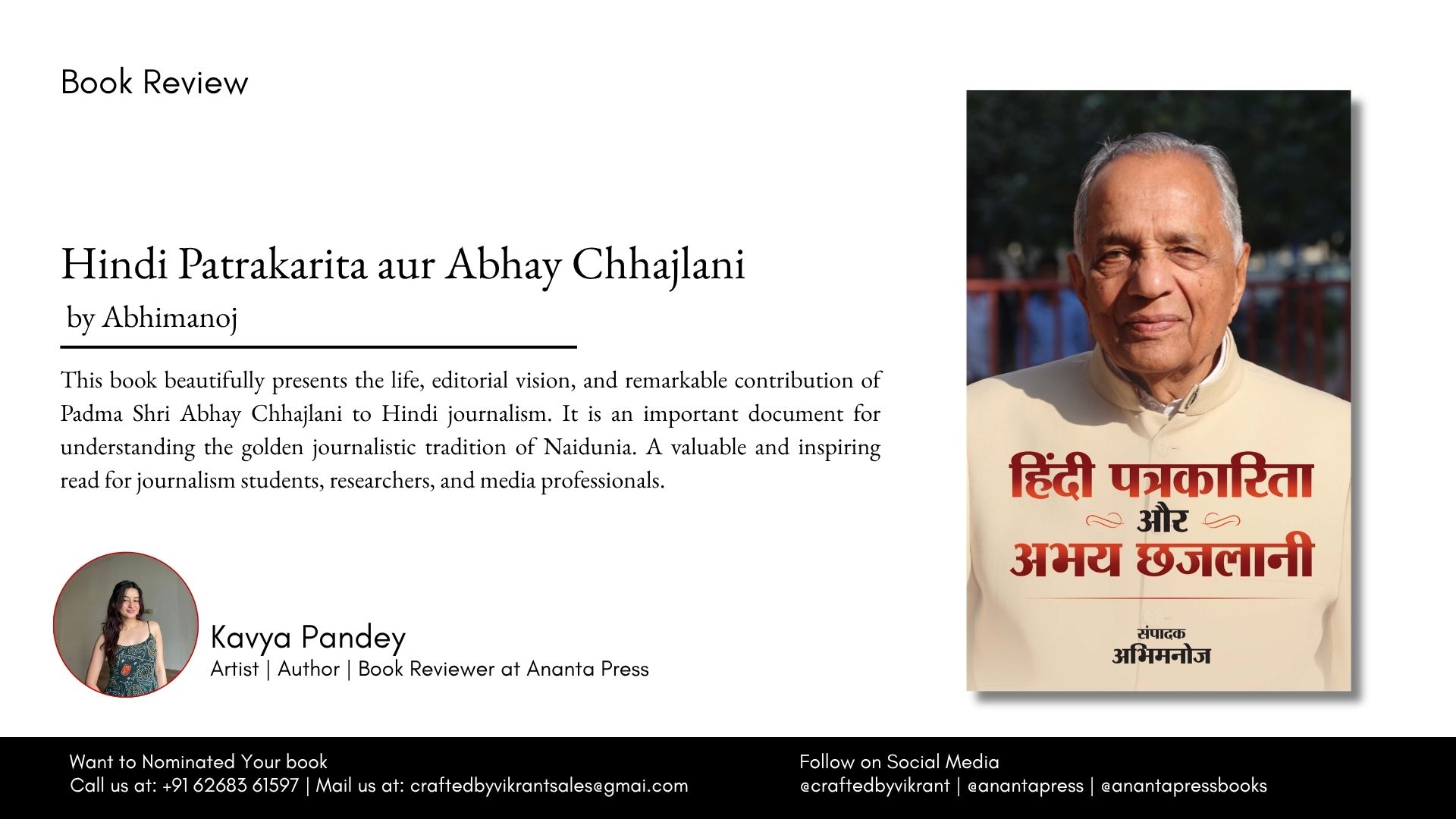
Hindi Patrakarita aur Abhay Chhajlani is much more than a commemorative volume dedicated to the life and work of Padma Shri Abhay Chhajlani. It is a valuable historical document that captures the spirit, values, challenges, and evolution of Hindi journalism through the lens of one of its most respected figures. Edited by senior journalist Abhimanoj, the book brings together memoirs, essays, tributes, speeches, and reflections from journalists, editors, writers, and colleagues who either worked with or were influenced by Abhay Chhajlani and the legendary newspaper Nai Duniya. The result is a rich and multidimensional portrait of a man who left an indelible mark on Indian journalism.
One of the book’s greatest strengths lies in its structure. Rather than presenting a conventional biography, the editor has compiled a collection of personal experiences and professional assessments from numerous contributors. This approach allows readers to understand Abhay Chhajlani from multiple perspectives. Through these varied voices, the book gradually reveals not only the personality of Chhajlani but also the culture of ethical journalism that he helped nurture. Each chapter contributes a unique piece to the larger mosaic, making the book engaging and authentic.
The introductory section by Abhimanoj serves as a powerful gateway into the world of Nai Duniya and the era it represented. He describes the newspaper as a “school of journalism” and a training ground for generations of journalists. His recollections highlight how Nai Duniya was not merely a newspaper but an institution dedicated to language, truth, social responsibility, and public trust. This context is essential because it helps readers appreciate why Abhay Chhajlani occupies such an important place in the history of Hindi journalism.
A particularly fascinating aspect of the book is the inclusion of Abhay Chhajlani’s own writings and speeches. These pieces allow readers to encounter his thoughts directly rather than solely through the memories of others. His essay reflecting on democracy, governance, and the common citizen demonstrates his intellectual depth and concern for social realities. His observations reveal a journalist who constantly questioned power structures and remained committed to the ideals of democracy. Even when expressing disappointment with public institutions, his writing reflects a constructive and thoughtful approach rather than cynicism.
Equally impressive is his speech on editing and journalism, delivered at a journalism workshop. In this address, Chhajlani discusses the changing nature of news, the influence of electronic media, the responsibilities of editors, and the evolving expectations of readers. Although delivered decades ago, many of his insights remain remarkably relevant today. His emphasis on editorial responsibility, language sensitivity, reader engagement, and ethical decision-making reflects a vision of journalism that prioritizes public service over sensationalism. Readers interested in media studies will find these sections particularly valuable because they provide practical wisdom from a seasoned editor who experienced major transformations in the media landscape.
Throughout the book, contributors repeatedly emphasize Chhajlani’s commitment to journalistic ethics. Numerous anecdotes illustrate how he defended editorial independence even when facing political pressure or criticism. One memorable example describes how he publicly explained an editorial decision when questions arose regarding a news report. Such incidents demonstrate his belief that credibility is the most valuable asset of a newspaper. Rather than protecting institutional pride, he prioritized transparency and public trust. These stories help explain why he earned such widespread respect among journalists and readers alike.
Another notable theme is mentorship. Many contributors credit Abhay Chhajlani with shaping their careers. The book portrays him not merely as a newspaper owner or editor but as a guide who recognized talent and encouraged professional growth. Several writers describe how he provided opportunities to young journalists, trusted them with responsibilities, and supported them in developing independent perspectives. This mentoring role emerges as one of his most enduring contributions to Indian journalism. His influence extended far beyond the pages of Nai Duniya because the journalists he nurtured went on to serve in leading media organizations across the country.
The book also provides valuable insights into the evolution of Hindi journalism after Indian independence. Through discussions of editorial practices, language standards, technological changes, and audience expectations, readers gain a deeper understanding of how newspapers adapted to changing times. Contributors often contrast the value-driven journalism of earlier decades with contemporary trends toward commercialization and sensationalism. While the book occasionally adopts a nostalgic tone, it does so without becoming overly romantic. Instead, it encourages readers to reflect on the principles that should continue to guide journalism in any era.
One of the most touching elements of the collection is the emotional warmth present in many contributions. The writers do not simply discuss Chhajlani’s professional achievements; they also remember his humanity, kindness, humility, and personal relationships. These recollections transform the book from a professional tribute into a deeply human narrative. Readers encounter a man who inspired loyalty and affection because of the respect he showed others. Such personal memories balance the analytical discussions of journalism and make the book emotionally engaging.
The language and style of the contributions vary because they come from different authors. However, this diversity ultimately strengthens the book. Some chapters are analytical, others are anecdotal, and still others are reflective or emotional. Together they create a dynamic reading experience. Readers never feel confined to a single perspective. Instead, they move through a broad landscape of memories, ideas, and experiences that collectively illuminate the significance of Abhay Chhajlani’s life and work.
From an academic standpoint, the book possesses considerable value. Journalism students, media researchers, and historians will find it useful as a source of firsthand accounts and reflections on the development of Hindi journalism. The essays provide insights into newsroom culture, editorial decision-making, language politics, media ethics, and the relationship between journalism and society. While the book is accessible to general readers, it also serves as an important reference for those studying Indian media history.
The editor deserves special appreciation for preserving these memories. By bringing together contributions from so many individuals, Abhimanoj has created a collective archive of journalistic experience. In an age when media institutions often focus on speed and immediacy, such efforts to document professional traditions and values become especially important. The book ensures that future generations can learn not only about Abhay Chhajlani but also about the broader journalistic culture he represented.
Of course, because the book is primarily a tribute volume, readers seeking a critical or balanced biography may find certain limitations. Most contributors write with admiration and affection, which means that critical perspectives are relatively limited. However, this does not diminish the book’s value. Its purpose is not to conduct an exhaustive biographical investigation but to preserve memories, experiences, and lessons associated with an influential journalist. Judged on those terms, it succeeds remarkably well.
In conclusion, Hindi Patrakarita aur Abhay Chhajlani is an inspiring, informative, and emotionally resonant work. It celebrates the life of a journalist who embodied integrity, courage, intellectual curiosity, and public responsibility. At the same time, it offers a broader reflection on the ideals that once defined—and should continue to define—journalism. Through its collection of memoirs, essays, speeches, and tributes, the book preserves an important chapter in the history of Hindi media. It is essential reading for journalists, journalism students, media scholars, and anyone interested in understanding the values that sustain a free and responsible press. More than a tribute to one individual, it is a tribute to the enduring spirit of ethical journalism itself.