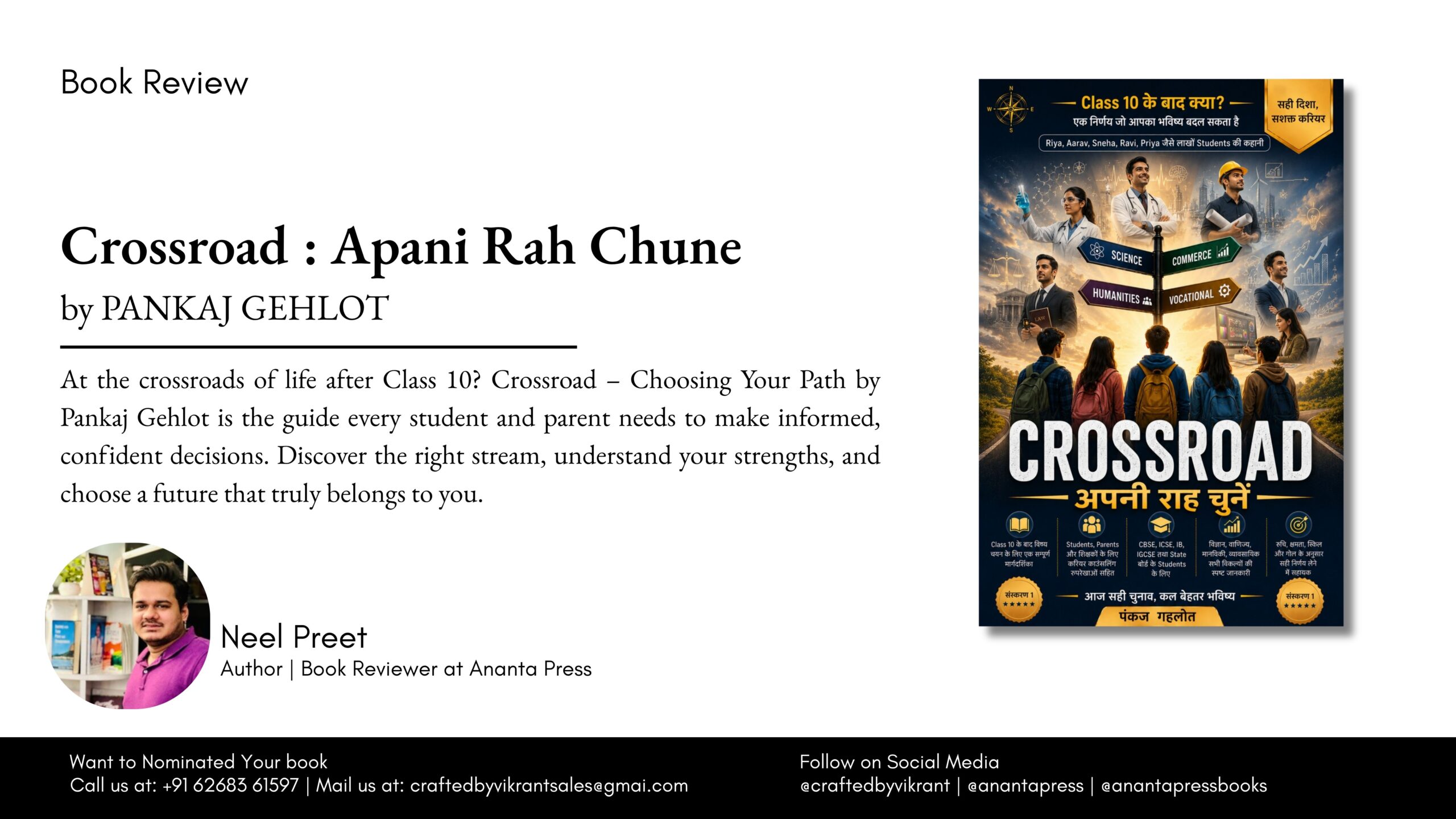
Choosing a stream after Class 10 is often considered one of the first major decisions in a student’s life. Yet, surprisingly, millions of students make this decision with limited information, incomplete self-awareness, and enormous pressure from family, peers, and society. It is at this exact point of confusion and uncertainty that Crossroad – Choosing Your Path by Pankaj Gehlot becomes not merely a book but an essential companion.
At first glance, one might assume that this is another career guidance book explaining the differences between Science, Commerce, and Humanities. However, the book quickly proves itself to be much more than that. It is a deeply thoughtful exploration of identity, decision-making, self-discovery, and the emotional realities surrounding career choices.
The author describes the book as a comprehensive, story-driven guide for students and families navigating one of the most emotional and significant decisions in Indian education—the selection of streams after Class 10.
What immediately distinguishes this book from conventional career guides is its human approach. Instead of beginning with statistics, admission criteria, or lists of career options, the author starts with something far more relatable—a confused student.
The story of Riya forms the emotional foundation of the book. She is intelligent, talented, and curious. Yet she finds herself torn between multiple interests and overwhelmed by conflicting advice. Her parents encourage Science. Teachers see potential in Commerce. Friends are moving toward Humanities. Everyone appears confident about what is best for her, except Riya herself.
This situation feels familiar because it represents the reality of countless students. Almost every teenager has experienced the uncomfortable feeling of standing at an educational crossroads while hearing numerous opinions but struggling to understand their own.
One of the book’s greatest strengths is its ability to normalize confusion. Rather than portraying uncertainty as weakness, it presents it as a natural part of self-discovery. The author repeatedly reminds readers that confusion often signals that a student genuinely cares about making the right decision.
Another remarkable feature of the book is its emphasis on self-awareness. Modern education systems frequently encourage students to chase marks and achievements while giving little attention to understanding themselves. Students know formulas, definitions, and examination patterns but often know very little about their interests, strengths, motivations, and long-term aspirations.
Crossroad – Choosing Your Path attempts to fill this gap.
The book encourages readers to ask meaningful questions:
- What subjects genuinely interest me?
- Which activities make me lose track of time?
- What kind of future can I imagine for myself?
- Am I choosing this stream because I want it, or because others expect it?
These questions may seem simple, but they have tremendous power. They shift the focus from external expectations to internal clarity.
Another aspect that deserves appreciation is the balanced treatment of all academic streams.
In many societies, especially in South Asia, Science is often considered the “top” stream, Commerce is viewed as practical, and Humanities frequently suffers from unfair stereotypes. Such perceptions create unnecessary hierarchy and pressure.
The author takes a refreshing approach by presenting each stream honestly and objectively. Science is not glorified. Commerce is not oversimplified. Humanities is not underestimated. Vocational education is not ignored.
Instead, each stream is presented as a legitimate pathway that can lead to meaningful and successful careers when aligned with a student’s abilities, interests, and goals.
This perspective is incredibly valuable because students do not need more pressure; they need more clarity.
The inclusion of career pathways further enhances the practical usefulness of the book. Many students and parents make decisions based on incomplete information. They often assume that one stream automatically guarantees success while another limits opportunities.
The author dismantles these assumptions by explaining how various educational choices can lead to diverse professional destinations. By broadening readers’ understanding of possibilities, the book empowers them to make informed choices rather than decisions driven by fear.
Equally impressive is the author’s treatment of parents.
Most career guidance books focus entirely on students. This book recognizes that parents are equally important participants in the decision-making process. Parents genuinely want their children to succeed. Their advice often comes from love and concern. However, love sometimes becomes pressure.
The book addresses this issue with sensitivity rather than criticism.
Parents are encouraged to ask questions, listen patiently, and understand their children’s individuality. They are reminded that support does not necessarily mean deciding on behalf of their children.
This message is particularly important because many educational conflicts arise not from lack of affection but from lack of communication.
The writing style of the book is another significant strength.
Pankaj Gehlot writes with remarkable simplicity and empathy. The language is accessible without being simplistic. The explanations are practical without becoming mechanical. The emotional sections feel genuine and relatable.
Throughout the book, the reader senses that the author is not speaking as a distant expert delivering instructions. Instead, he appears as a mentor who has listened to students, understood their struggles, and sincerely wants to guide them toward clarity.
The storytelling approach also makes the content engaging. Educational guidance books sometimes become overwhelming because they are heavily packed with information. This book avoids that problem by integrating stories, examples, and reflections that keep readers emotionally invested.
Another noteworthy contribution of the book is its advocacy for professional career counselling.
Many families still believe that students should independently figure out their educational paths. However, the modern world offers countless opportunities and increasingly complex career landscapes. Expecting teenagers to navigate these choices entirely alone is unrealistic.
The author strongly argues that structured guidance and career counselling should not be considered luxuries available only to a few. Instead, they should be recognized as essential support systems that help students make informed decisions.
This argument deserves serious attention from educators and policymakers alike.
Perhaps the most powerful message of the entire book is that subject selection is not about closing doors; it is about opening the right ones.
This simple idea transforms the entire conversation around education.
Students often approach stream selection with fear. They worry that one wrong decision will permanently destroy their future. Such thinking creates anxiety and leads many students to choose paths that do not align with their personalities.
The book replaces fear with perspective.
It reminds readers that educational choices are meaningful but not irreversible. The objective is not to find a perfect stream that guarantees success. The objective is to make thoughtful, informed decisions that align with who they are and who they wish to become.
This emphasis on ownership and self-awareness is what gives the book lasting value.
Ultimately, Crossroad – Choosing Your Path succeeds because it understands something fundamental: career decisions are never merely academic decisions. They are deeply human decisions involving identity, dreams, expectations, fears, and hope.
The book offers information, but more importantly, it offers understanding.
It gives students permission to reflect before deciding. It gives parents a framework for supporting rather than directing. It gives educators a practical resource for guiding young minds.
Most importantly, it gives confused students something they desperately need—a map.
Final Verdict
⭐⭐⭐⭐⭐ 5/5
Crossroad – Choosing Your Path is not just a career guidance book; it is a thoughtful companion for every student, parent, teacher, and counsellor navigating one of life’s first major crossroads. Compassionate, practical, and deeply relevant, this book deserves a place in every school library and in every home where a student is preparing to choose a path after Class 10.