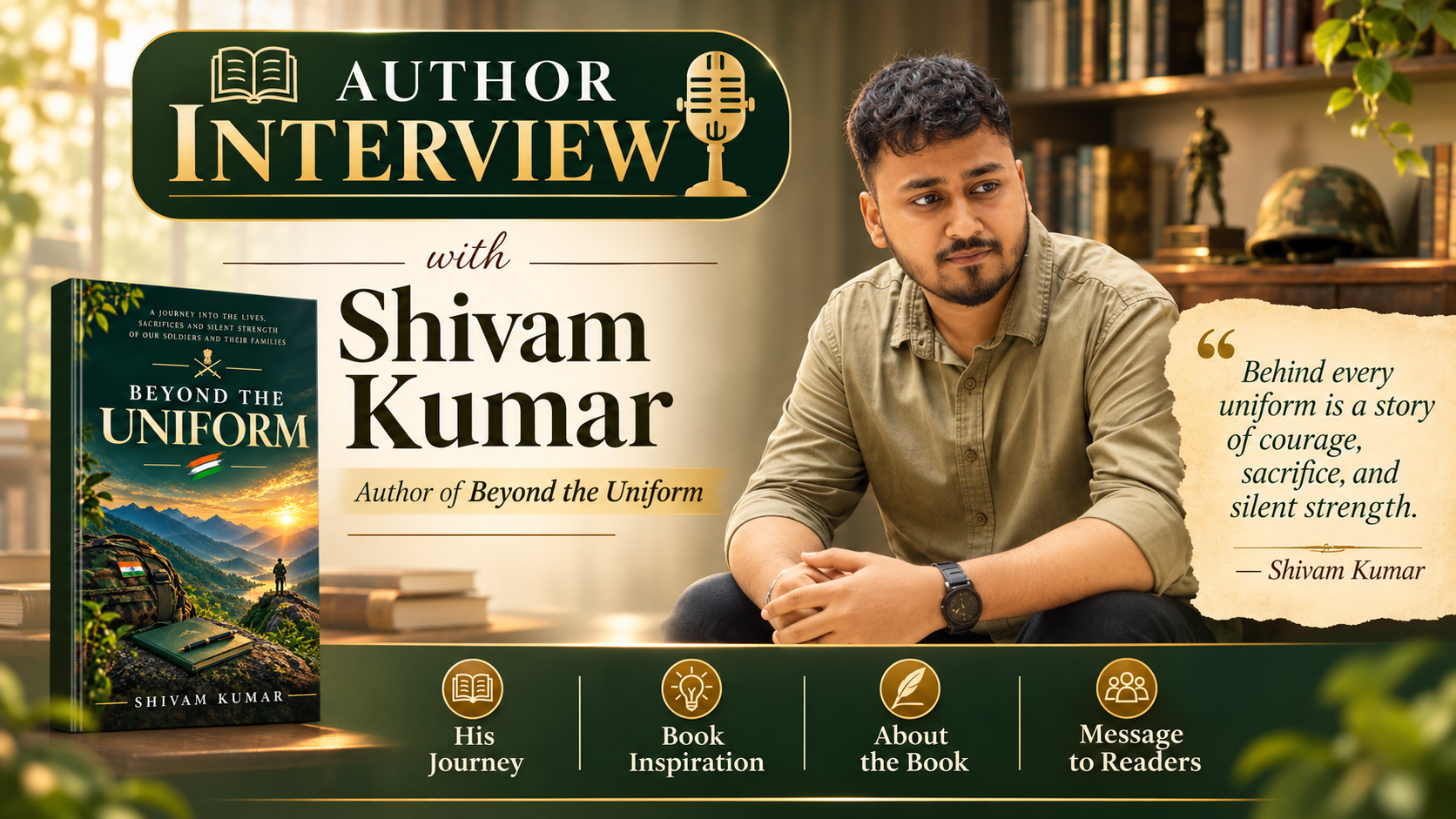
1.What inspired you to write Beyond the Uniform, and how did your father’s journey in the Indian Army influence your decision?
Answer — The inspiration behind Beyond the Uniform came from my own life as an Army kid and from the things I witnessed growing up in an Army family.
My father’s journey in the Indian Army has influenced my life in ways that are difficult to put into words. He has served in challenging areas, including Jammu, Ladakh and Arunachal Pradesh, and there were times when we hardly got to spend time together. We didn’t always live in cantonment areas, so I grew up missing my father while my mother managed almost everything at home on her own. Watching her handle responsibilities, uncertainties and the emotional challenges of being an Army wife made me realise that military life is not only about the person wearing the uniform; it is equally about the people standing behind them.
There are certain incidents in my family that made me understand this even more deeply. My mother once told me that during the early days of their marriage, my father had received a gunshot injury to his hand. It was something very few people knew about, and even today, it remains a part of our family’s untold story. It made me wonder how many such experiences soldiers carry silently and how many sacrifices their families make without ever speaking about them.
Losing my grandmother also made me more conscious of the fear of losing loved ones. With my father often posted in difficult and sensitive areas, I would sometimes overthink, follow the news and imagine the worst possible situations. I believe many Army children and families experience similar emotions, even if they don’t always express them.
All these experiences gradually gave birth to the idea of Beyond the Uniform. I wanted to write about the human side of soldiers — their fears, emotions, families, relationships and the silent sacrifices that often remain unnoticed. I wanted to explore what happens beyond their professional identity: the father someone waits for, the husband someone misses, the son a mother prays for, and the human being behind the uniform.
For me, this book is not just about soldiers or their service; it is about the lives connected to them. It is my small attempt to give a voice to stories and emotions that often remain untold, and to make readers understand that behind every uniform, there is a human story.
2.Your book highlights the emotions and sacrifices of soldiers’ families. Why did you feel these untold stories deserved more attention?
Answer — Yes, my book highlights the emotions and sacrifices of soldiers’ families, and I strongly believe these untold stories deserve more attention because a soldier’s sacrifice is never his alone.
Whenever a soldier does something heroic or makes the ultimate sacrifice on the battlefield, we rightly celebrate his bravery and courage. But somewhere, we often forget the family standing behind that uniform. We talk about the soldier, but rarely talk about the mother who waits for her son, the wife who manages an entire life in his absence, or the children who grow up missing their father’s presence.
The truth is that a soldier is able to serve the nation with dedication because, somewhere back home, a family stands beside him with strength, patience and unconditional support. Their fears, sleepless nights, compromises and silent sacrifices are also a part of his journey.
Being an Army kid, I have seen and understood a small part of this life. That personal connection made me realise that there is a whole world of emotions behind the uniform that people rarely get to see.
That is why I wrote Beyond the Uniform. I wanted to shift the focus from just the uniform to the human being wearing it, and to the people whose lives are equally connected to his service. Through this book, I want readers to understand that behind every soldier stands a family that serves in its own silent way.
Because the uniform represents one soldier, but the sacrifice often belongs to an entire family.
3.In the chapter The Mother Who Never Sleeps, you explore a mother’s silent fears. What inspired you to portray this emotional struggle?
Answer — The inspiration behind this chapter comes from a very personal experience in my family.
When my father was posted in Jammu, I remember how my family used to follow the news regularly. I particularly remember my grandmother. She was someone who hardly ever watched the news, but during that period, she started watching it every day. She would worship more often and constantly ask about my father. I still remember her saying, “Shiv ji khayal rakhenge, raksha karenge Pitaji ki.”
At that age, I understood the fear of a son waiting for his father to return safely. But as I grew older, I began to understand something deeper. I realised that if I, as a son, could feel so much fear for my father, imagine what his mother must be going through. She was the person who had given him life, raised him and watched him grow. Her fear and prayers must have carried a different depth altogether.
That experience stayed with me and eventually inspired me to write The Mother Who Never Sleeps.
In this chapter, I also share the story of a soldier from the Kumaon Regiment whose mother prayed to Varahi Mata for her son’s protection. Her prayers, faith and silent strength represent the emotions of countless mothers whose fears rarely find a place in the stories we tell about soldiers.
Through this chapter, I wanted readers to understand that while a soldier stands on the frontlines protecting the nation, somewhere back home, a mother is fighting her own silent battle through prayers, hope and endless waiting.
4.How did your personal experiences as an Army officer’s son shape the chapter Children of the Uniform?
Answer — The chapter Children of the Uniform is probably one of the most personal chapters in my book because it is largely inspired by my own childhood experiences as an Army kid.
During my teenage years, I used to miss my father a lot. I would see my friends spending time with their fathers, celebrating festivals together, and having them around for everyday moments. But my father was often away because of his postings and responsibilities. I still remember missing him on festivals like Diwali, when I wished he could be home with us.
At that age, I couldn’t fully understand why he had to be away. I only knew that I missed my father and wanted him around. But as I grew older, my perspective changed. I began to understand that my father wasn’t choosing to miss those moments; he was fulfilling a responsibility much bigger than himself — protecting our nation.
After losing my grandmother, I also experienced a fear of losing the people closest to me. It made me overthink many things and understand how deeply. the fear of separation can affect a person.
I brought these personal emotions and experiences into Children of the Uniform. I wanted to express what an Army child goes through — the missing, the waiting, the emotional adjustments and the gradual understanding of a parent’s duty.
I believe nobody can explain the everyday emotions of an Army child better than someone who has experienced that childhood. Through this chapter, I wanted other Army kids to find a reflection of their own lives and other readers to understand that when a soldier serves the nation, his children are also growing up with their own share of sacrifices.
5.Your book discusses the invisible sacrifices made by soldiers’ wives. What message do you hope readers take away from these stories?
Answer — Through the chapter The Wife Who Fights Invisible Wars, I wanted readers to recognise the strength and bravery of a soldier’s wife, because I feel her sacrifices often go unnoticed.
When a soldier is away serving the nation, his wife takes responsibility for almost everything back home. She manages the children, takes care of the family, handles household responsibilities, makes important decisions and faces everyday challenges, often without her husband’s physical presence.
But what makes her journey even more emotional is that she rarely expresses what she is going through. There are days when she feels lonely, misses her husband, needs emotional support or simply wishes someone would ask if she is doing okay. Yet, she continues to manage everything and remains strong for her children and family.
I want readers to understand that this strength doesn’t mean she never feels sad, afraid or exhausted. She is human too. Her bravery lies in carrying all these responsibilities and emotions while making sure her family never feels unsupported.
Through this chapter, I wanted to show that a soldier’s wife is also fighting her own invisible battles. While her husband serves the nation at the borders, she holds the family together at home.
And I hope readers realise that her contribution deserves the same respect, recognition and appreciation as the sacrifices we celebrate in a soldier’s uniform.
6.While writing about Captain Vikram Batra and other soldiers, which story affected you the most emotionally, and why?
Answer — Among all the stories I explored while writing about Captain Vikram Batra and other brave soldiers, the story of Havildar Sukhraj Singh affected me the most emotionally.
What stayed with me was his last conversation with his little daughter, in which he promised to bring her toys when he returned. Sadly, he could never fulfil that promise. What makes this story even more heartbreaking is that his daughter had no idea that this would be her last conversation with her father.
Whenever I think about this incident, I try to put myself in that little girl’s position. Imagine waiting for your father to return with the toys he promised, without even knowing that he is never coming back. At such a young age, she couldn’t possibly understand the magnitude of what had happened or the emptiness that would follow.
Perhaps that is what affected me the most—not just the sacrifice of a soldier, but the innocent childhood of a daughter that changed forever. This story reminded me that behind every soldier’s sacrifice, there is a family carrying a lifetime of emotions, memories and unfulfilled promises.
7.In The Weight of the Uniform, you explore responsibility beyond bravery. What do you believe is the greatest challenge a soldier faces?
Answer — In the chapter The Weight of the Uniform, I tried to explore the responsibilities a soldier carries beyond the uniform. According to me, one of the greatest challenges a soldier faces is not just the difficult terrain, extreme weather or harsh conditions in which they serve, but also their emotional connections with the people they leave behind.
People often consider standing at high altitudes, facing enemies and surviving difficult conditions to be the biggest challenges of military life. And undoubtedly, they are. But imagine standing thousands of kilometres away from your family, missing your loved ones, and still performing your duties with complete commitment.
There is another thought that I believe often crosses a soldier’s mind: What will happen to my family if something happens to me? When you serve in places where uncertainty is a part of everyday life, you know that anything can happen at any moment. A soldier is not only concerned about his own life; he also carries the responsibility and worry of the family that depends on him.
That emotional battle is something people rarely talk about. Through this chapter, I wanted readers to understand that the weight of the uniform is not limited to the responsibilities visible on a soldier’s shoulders. It also carries the weight of love, distance, fear, family and countless unspoken emotions.
8.How did you balance your personal memories, research, and real-life accounts while writing the 14 chapters of this book?
Answer — Balancing personal memories, research, and real-life accounts across all 14 chapters was honestly not easy for me. Every chapter has some personal connection, and I have my own memories or experiences related to almost every subject I have explored.
But I also felt that if I wrote only about my own experiences, readers might feel that I was simply glorifying my family or my father’s journey in the Indian Army. I wanted Beyond the Uniform to be much bigger than just my personal story.
That was one of the reasons I decided to explore the lives of other Army families and listen to their experiences. When people started sharing their stories, I realised how deeply emotional and meaningful some of them were. I then began selecting real-life accounts and research for each chapter with a particular thought in mind: Will this story help readers understand this chapter better? Will it make them feel the emotions more deeply and connect with the subject?
So, I tried to place every personal memory, researched fact, and real-life account where it genuinely added value to the chapter. My aim was never just to fill pages with stories but to make every story meaningful and relevant.
And honestly, I still couldn’t include so many stories that I wanted to share. Agar sab likhne baithta, toh aap sabko ek hi book ke liye bahut zyada padhna padta! 😅
9.What was the most emotional moment you experienced while writing about your father, particularly his sacrifices and your childhood memories?
Answer — The most emotional moment for me was writing the chapter Children of the Uniform. Unlike some other chapters, this one was deeply personal because I expressed feelings and memories that I had never really shared with anyone.
While writing it, I became quite emotional because every sentence brought back memories of my childhood, my father’s absence during important moments, and the feelings I usually find difficult to express, even to Pitaji. There were many things I wanted to write but couldn’t include in the chapter, and even the things I did write were not easy to put into words.
One thing I would like to share is that after completing the chapter, I sent that particular note to my Didi. She started crying after reading it. Even one of my friends became emotional.
That reaction made me realise that sometimes the feelings we struggle to express in our daily lives can reach people more deeply when we put them into words. For me, Children of the Uniform was not just another chapter; it was a way of expressing everything I had kept inside for years.
10.After reading Beyond the Uniform, what change would you like to see in how people understand and appreciate soldiers and their families?
Answer — After reading Beyond the Uniform, I would like people to change the way they perceive soldiers. Often, when we think of a soldier, we imagine someone who is aggressive, disciplined, rough and tough. But beyond that strong personality, there is a deeply emotional human being who is someone’s son, husband, brother, father or daughter.
I want readers to understand that soldiers are not just defined by their bravery, sacrifices or the uniform they wear. They have emotions, fears, relationships and families too. They miss their loved ones, worry about their families and sometimes carry emotions they cannot even express.
And most importantly, I want people to appreciate not just the soldier but also the family standing behind that uniform. A soldier’s courage is often supported by a mother who waits, a wife who manages everything alone, and children who grow up missing their parent.
I don’t want people to stop praising soldiers’ bravery; I just want them to extend that appreciation to their families as well. Because the uniform may belong to one person, but its sacrifices are often shared by an entire family.