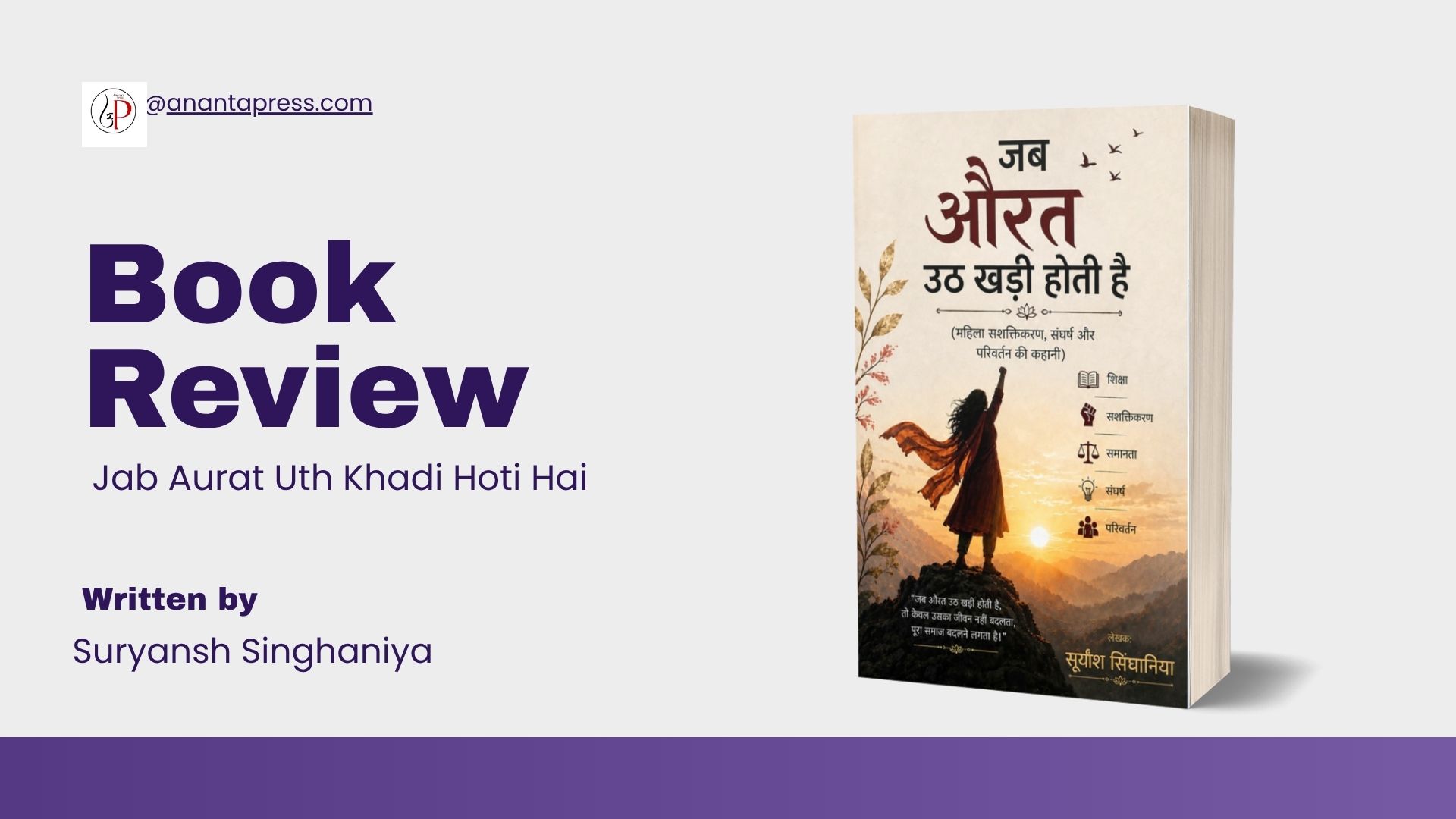
Jab Aurat Uth Khadi Hoti Hai is a thoughtful and socially relevant book that discusses women’s empowerment, equality, education, struggle, and social transformation in simple yet emotionally impactful language. Written by young author Suryansh Singhania, the book focuses on the condition of women in Indian society and explains how women’s progress is directly connected with the progress of society itself. The title itself carries a strong and inspiring message — when a woman rises, she not only changes her own life but also transforms the future of the entire society.
The book begins with a powerful introduction in which the author highlights the contradiction present in society. Women are often worshipped as goddesses in culture and tradition, yet many women are denied equal rights, opportunities, education, and freedom in real life. The author explains that women form half of society and play a central role in building families and communities, but historically they have been restricted within social boundaries created by patriarchal thinking. The author’s writing is emotional yet balanced, and it immediately creates a connection with readers who are aware of the inequalities women still face in many parts of the world, especially in rural India.
One of the strongest aspects of this book is its simplicity. The language is easy to understand, which makes the book accessible to readers of all age groups. Instead of using overly academic or complex language, the author chooses a direct and heartfelt style. This simplicity increases the emotional impact of the message. Readers who are not familiar with discussions about feminism or social reform can still understand the ideas clearly. The book does not try to sound intellectual for the sake of complexity; rather, it focuses on communicating important social truths in a relatable manner.
The first chapters discuss the historical condition of women and the rise of patriarchy in society. The author explains how women were gradually limited to domestic roles while men controlled decision-making, property, politics, and education. The book clearly describes how patriarchal systems developed over time and how they affected women’s freedom and opportunities. The discussion is not aggressive or hateful toward men; instead, it encourages readers to understand social structures critically and work toward equality. This balanced approach makes the book more constructive and meaningful.
Another important theme explored in the book is education. The author repeatedly emphasizes that education is the strongest tool for women’s empowerment. According to the book, when a girl receives education, it does not only transform her life but also influences future generations. Educated women contribute to the development of healthier families, economically stable households, and socially aware communities. This idea is presented throughout the book with emotional conviction. The author successfully explains that denying education to girls weakens society itself. The repeated message that “when a girl studies, generations change” becomes one of the emotional foundations of the book.
The sections focusing on rural women are especially impactful. The author presents the realities faced by women in villages where education, healthcare, and opportunities are often limited. Girls are sometimes forced to leave school because of poverty, social customs, or gender discrimination. The book explains how many talented and intelligent women never get the chance to realize their potential simply because society underestimates them. These chapters are emotionally powerful because they reflect the reality of countless families in India. Readers from rural backgrounds may especially connect with these discussions.
The book also talks about the challenges women continue to face in everyday life, including discrimination, economic dependency, lack of decision-making power, child marriage, and unequal treatment. The author explains that even though progress has been made, many women still struggle for basic dignity and equality. The discussion about economic independence is particularly meaningful because the author highlights how financial freedom can increase women’s confidence and social standing. The book encourages society to recognize women’s labor and contributions both inside and outside the home.
One of the most inspiring sections of the book is the chapter about great women in history. The author discusses influential figures such as Savitribai Phule, Rani Lakshmibai, Sarojini Naidu, Kalpana Chawla, Kiran Bedi, and Indira Gandhi. These examples make the book motivational because they show how women have broken barriers in education, politics, science, administration, and social reform. The stories remind readers that courage and determination can challenge even the strongest social limitations.
The discussion about the Indian Constitution and women’s rights adds depth to the book. The author explains constitutional rights such as equality before law, protection against discrimination, and equal opportunity in employment. This section is informative and educational, especially for young readers who may not fully understand their constitutional rights. The author also mentions laws related to women’s protection and safety, emphasizing that social awareness must grow alongside legal reforms. This combination of social thought and constitutional understanding gives the book educational value beyond emotional storytelling.
A notable quality of the book is its hopeful tone. Even while discussing serious social problems, the author continuously focuses on the possibility of change. The book repeatedly argues that society is slowly changing and that education and awareness are creating new opportunities for women. Instead of presenting women only as victims, the book portrays them as agents of transformation. This positive and empowering perspective makes the reading experience inspiring rather than depressing.
The emotional strength of the book comes from its repetitive but effective central idea: when women rise, society rises with them. This thought appears throughout the chapters in different forms and contexts. Although some readers may feel that the repetition is excessive, it also reinforces the book’s core message strongly. The repeated lines act almost like motivational reminders that keep the reader emotionally connected to the purpose of the book.
At the same time, the book has a few limitations. Readers looking for deep academic analysis or detailed statistical research may find the discussion somewhat basic. The author focuses more on emotional appeal and social awareness than on scholarly argument. Some chapters repeat similar ideas about education, equality, and empowerment. A more diverse range of examples, case studies, or personal stories could have added greater depth and variety to the narrative. However, considering that this is the author’s first book, the effort remains impressive and meaningful.
Another limitation is that the book mainly discusses women’s struggles from a broad social perspective rather than exploring individual psychological experiences in detail. There are no fictional characters or personal narratives guiding the reader emotionally through specific journeys. The book functions more as a social awareness text than a traditional narrative work. Yet this style also works in its favor because it keeps the focus on ideas and social reform rather than entertainment.
The author’s sincerity is visible throughout the book. Suryansh Singhania writes with genuine concern for equality and social justice. The writing reflects a young voice deeply interested in social issues, education, and constitutional values. The book succeeds in encouraging readers to think about how women are treated in families, schools, workplaces, and society. It pushes readers to question traditional thinking and recognize that empowering women benefits everyone.
The structure of the book is also organized well. Each chapter focuses on a particular theme such as history, patriarchy, education, leadership, constitutional rights, rural women, or social transformation. This organization makes the book easy to read and understand. Readers can read it chapter by chapter without feeling lost. The gradual progression from historical inequality to modern empowerment creates a clear flow in the narrative.
Overall, Jab Aurat Uth Khadi Hoti Hai is an inspiring and socially conscious book that highlights the importance of women’s empowerment in building a better society. It is not merely a discussion about women’s struggles; it is a call for awareness, equality, education, and respect. The book succeeds in delivering a strong moral and social message through simple language and emotional sincerity. It encourages readers to believe that social change is possible when society supports women with education, opportunities, dignity, and freedom.
This book is especially suitable for young readers, students, teachers, and anyone interested in social awareness and gender equality. It can also serve as a motivational and educational text in schools and colleges because of its accessible language and positive message. The author deserves appreciation for choosing such an important subject and presenting it with clarity and passion.
In conclusion, Jab Aurat Uth Khadi Hoti Hai is a meaningful contribution to discussions on women’s rights and social transformation. Its greatest strength lies in its emotional honesty and hopeful vision for society. The book reminds readers that empowering women is not only a matter of justice but also the foundation of social progress. By the end of the book, readers are left with a strong realization that true development is impossible unless women are given equal opportunities and respect. The message remains clear and powerful throughout the work.