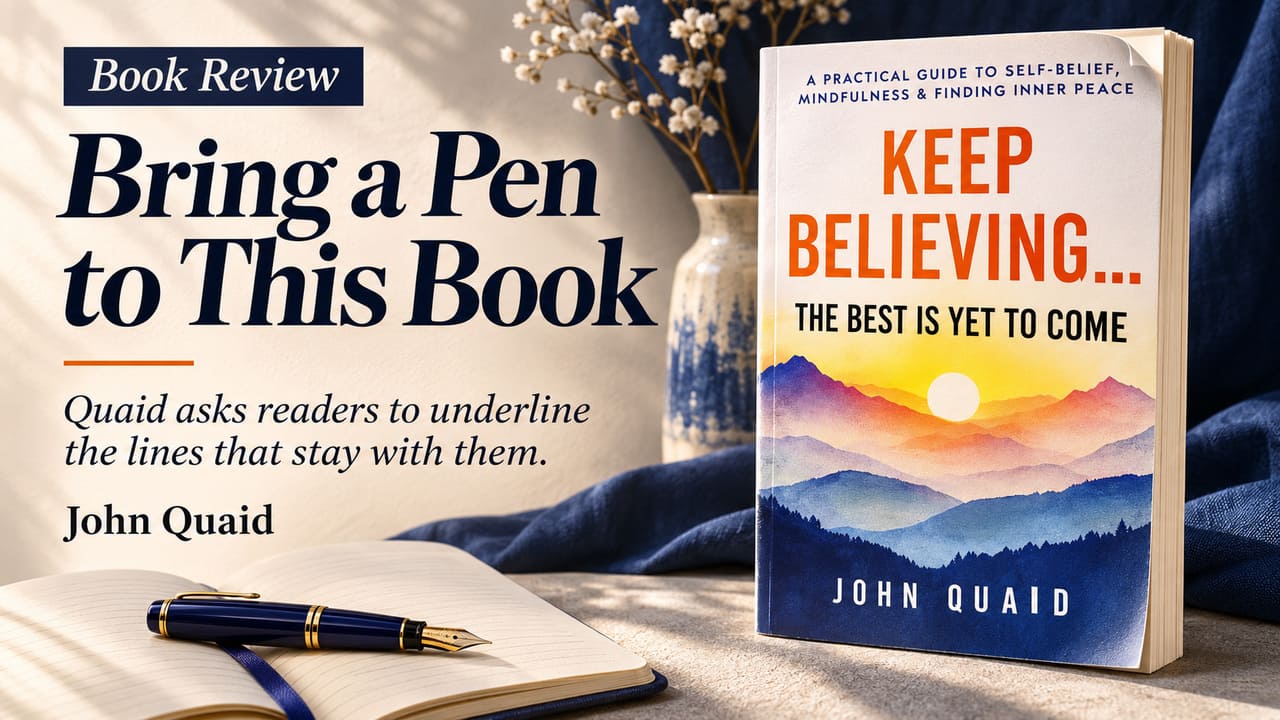
Some books are easy to agree with and easy to forget. A sentence feels true, the next page turns, and nothing in the reader’s day has to answer it. John Quaid’s Keep Believing… The Best Is Yet to Come makes an explicit attempt to interrupt that comfortable arrangement. In the supplied introduction, he asks readers to keep a pen nearby and underline what lands. It is a small instruction, but it provides a useful standard for judging the book: does the writing create something worth thinking about after reading stops?
The title and subtitle identify an ambitious territory: self-belief, mindfulness and inner peace. The supplied media pack describes eleven chapters, each ending with reflection. The available sample does not include all those exercises, so their individual design cannot be assessed here. What can be assessed is the participatory approach established by the introduction and Chapter 1. Quaid addresses the reader directly, asks questions and treats self-observation as an active part of the encounter. Passive inspiration is clearly not his only intention.
Begin with the question you can answer
The first chapter asks, “How much time do you spend on yourself each day?” The question looks simple until the author clarifies what he means. He is asking about attention to one’s inner experience, rather than time spent completing work or meeting responsibilities. That distinction creates a useful opening for reflection because it makes the reader examine a familiar word. Time may be occupied with activities related to the self without containing much awareness of what the self is experiencing.
This is where the book’s approachable language helps. Quaid does not require the reader to define a psychological concept before participating. He begins with the shape of a day. A thoughtful answer may expose a discrepancy between stated priorities and habitual attention. It may also reveal that some readers already have reflective practices the book’s broad address does not fully acknowledge. Either response is worthwhile. A useful question should leave room for an honest answer, including one that complicates the author’s assumptions.
The next move is observation without immediate judgment. Quaid asks the reader to notice patterns, reactions and habits before trying to correct them. This gives the writing exercise a clear purpose. Notes can capture what occurred rather than become a list of personal shortcomings. The approach is especially welcome in a genre where improvement can easily become another performance. If the reader turns every reflection into a grade, the practice risks reproducing the pressure that the book is trying to examine.
Read the example before accepting the principle
The sampled chapter contains a useful case study in the author’s own meeting behaviour. His wish to appear knowledgeable interfered with listening. A leader’s observation about his being mentally ahead of everyone else helped him see that speed was creating distance. These passages give readers something more substantial than an abstract instruction to become aware. They show what a pattern looks like in a particular setting and how another person’s feedback can make it visible.
They also encourage a disciplined way of reading self-help. Rather than underlining every confident sentence, a reader can ask which example supports it and where its limits might lie. Quaid’s narrative makes a strong case for examining the desire to be right. It makes a less complete case for broad claims that inner change always precedes meaningful outer change. A notebook can hold both responses. Agreement and doubt do not need separate books. The same text can supply an insight and a proposition worth challenging.
A practical way to engage with the material
The following reading suggestions arise from this review; they are not reproduced exercises from Quaid’s unseen chapters.
- Choose one passage that describes an observable behaviour. The meeting scene is a good example because listening, interrupting and preparing an answer can be distinguished more clearly than a general feeling of being transformed.
- Write down why the passage seems relevant, or why it does not. A personal response is more useful than copying an attractive sentence without considering whether it describes your circumstances.
- Identify a modest situation in which the idea could be considered. Avoid turning a single reading session into a promise to reorganise an entire life. The purpose is to connect reflection with something recognisable.
- Return later and reconsider the interpretation. A first reaction may be incomplete. Rereading can reveal that what initially looked like selfishness was a boundary, or that what felt like confidence also contained defensiveness.
This kind of participation fits the permission to slow down that appears in Quaid’s introduction. The reader may put a challenging chapter aside and come back when ready. That is an unusually relevant instruction in a book about attention, because it gives the reader control over pace. The method is not judged by how quickly the material is consumed. It is judged by whether there is enough room to consider what the language has brought into view.
What the reader testimony can tell us
Emily King, in the supplied review pack, reports keeping a pen handy and taking notes from several chapters. Her comment is useful because it describes a concrete reading behaviour that matches the author’s invitation. It does not establish that the reflections produce a particular outcome, and one reader’s enthusiasm cannot stand for everyone. Nevertheless, it suggests that the book’s intended mode of engagement was visible to at least one early reader. The invitation to participate was noticed, not merely printed.
Other testimonials describe returning to the book or finding different ideas relevant at different stages. That response makes sense for a text built around recurring themes rather than a plot dependent on surprise. Its possible rereading value lies in the changing position of the reader. A passage about approval may mean little during one period and become more interesting after an uncomfortable conversation. This is a plausible use of reflective writing, though the sample alone cannot establish the depth or variety of every later chapter.
There are limitations to the format as presented. A chapter-ending reflection can create a useful pause, but it can also remain vague if it does not lead beyond broad self-description. Because the complete exercises were not supplied, this review cannot determine which is true throughout the book. Prospective readers should therefore understand the recommendation precisely. The opening establishes a thoughtful reading posture and several accessible questions. It does not, on the available evidence, demonstrate a comprehensive workbook or a structured programme with defined outcomes.
The prose is well suited to readers who prefer a conversational companion to a densely argued manual. Its repetition may support slower reflection, although some passages could be tighter. Its most productive moments connect the author’s candid experiences with questions the reader can genuinely answer. Keep Believing appears worth approaching with a pen because it invites a response rather than mere applause. Bring willingness, but bring judgment too. A useful reading may be the one that leaves you with a more precise question about your own day.
Get Your Copies: mybook.to/OrderKeepBelieving.