
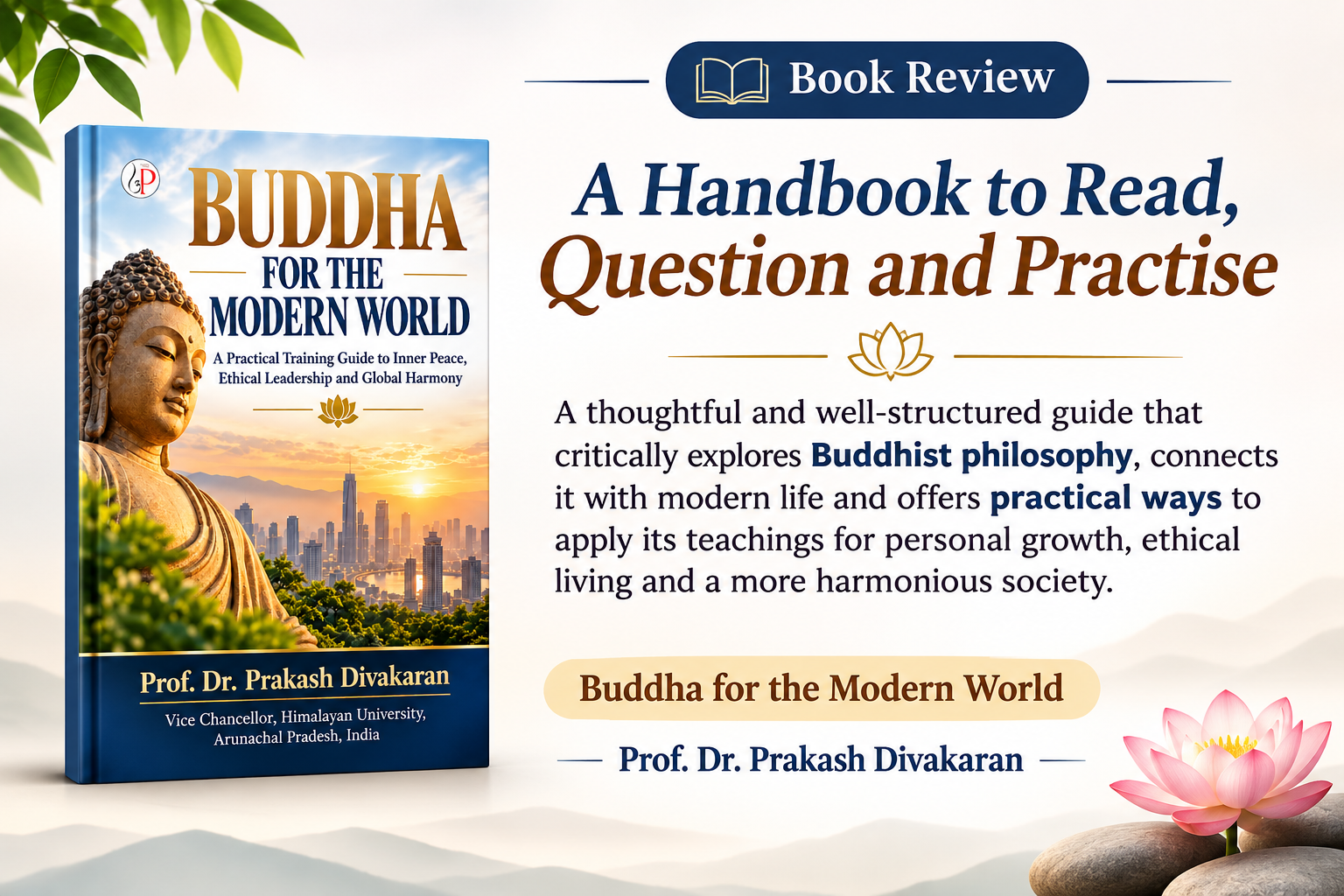
Buddha for the Modern World | Prof. Dr. Prakash Divakaran
Some books are designed to be read once and remembered for their central argument. Others are intended to accompany readers through an extended process of learning. Buddha for the Modern World: A Practical Training Guide to Inner Peace, Ethical Leadership and Global Harmony belongs firmly to the second category. Prof. Dr. Prakash Divakaran organizes the work around thirty-eight chapters that develop Buddhist principles through explanations, practical comparisons, exercises and reflective activities. This review examines the book as a teaching resource and philosophical introduction, considering not only what it says but how effectively its structure helps readers engage with the material. The combination of historical orientation, accessible language and sustained practical training is its distinguishing characteristic. Its educational ambition is substantial: the author seeks to make a tradition of profound philosophical and ethical inquiry intelligible to readers who may be encountering it for the first time.
Organization and progression
The arrangement of the chapters deserves attention because it reflects a deliberate sequence of learning. The early material establishes contemporary relevance before introducing the Buddha’s biography and historical setting. Chapters on suffering, the Four Noble Truths and the Noble Eightfold Path then provide a conceptual foundation. The separate chapters devoted to each factor of the Eightfold Path allow for a more patient examination of its implications. Subsequent material develops meditation, emotional awareness, attachment, change, non-self, compassion and ethical consequence. Only after this foundation does the book move extensively into relationships, professional leadership, institutional responsibility and global harmony. The progression works well for a handbook because it prevents the later applications from appearing entirely disconnected from the philosophical tradition that informs them. Readers can also use the contents as a reference guide, returning to particular topics as their needs change.
Philosophy as an invitation to inquiry
The book’s approach to the Four Noble Truths provides an instructive example of its strengths and possible limits. Divakaran explains them through the accessible framework of diagnosis, cause, outcome and path. The comparison is particularly helpful for readers accustomed to structured problem-solving in management, education or technical professions. It makes it possible to understand why the recognition of suffering is followed by investigation and practice rather than simple resignation. However, the traditional teachings concern liberation from suffering in a much broader sense than resolving an immediate problem at work or at home. The educational analogy should therefore be seen as a bridge from contemporary experience toward philosophical understanding. Its value is not that it reduces Buddhism to a management technique, but that it gives an unfamiliar reader reasons to examine the teachings more seriously. The book often succeeds in preserving this spirit of inquiry through its encouragement of observation and reflection.
A workbook built around observation
Perhaps the most distinctive formal feature is the recurrent use of exercises. The opening chapter recommends a dedicated notebook, a manageable daily reading schedule and periodic review. Rather than encouraging the reader to absorb several chapters rapidly, it proposes a slower process in which ideas are tested against ordinary experience. The exercise on personal turning points, for instance, invites readers to identify events that altered their direction and reflect on what they learned from them. A later method for investigating stress separates factual events from bodily sensations and interpretations. These activities provide opportunities to translate broad concepts into specific observations. They also create a record that can be reconsidered over time. A reader who initially believes a certain difficulty occurs unpredictably may begin to recognize recurring conditions through written reflection. The exercises are educational tools rather than guarantees of any particular outcome, and that distinction should remain clear when they are used in formal learning settings.
The comparison tables perform another important instructional function. In the opening material, they summarize modern pressures and possible manifestations. The biography chapter contrasts indulgence, severe austerity and balanced training. The chapter on digital attention connects common platform features with their possible effects and deliberate responses. These tables help a reader retrieve an idea without searching through numerous paragraphs. They are particularly suitable for independent study, where learners may lack regular opportunities to ask questions of a teacher. Their frequency can also make the text feel somewhat schematic. Philosophical nuances do not always fit comfortably into compact columns, and some readers may prefer longer discussions of the relationships between concepts. Nevertheless, the tables are effective when treated as guides to understanding rather than complete accounts. They make the manuscript’s considerable range easier to navigate and encourage readers to distinguish concepts that might otherwise merge together.
Learning across different contexts
The interdisciplinary scope is another source of educational value. The chapters on Right Speech and Right Action can support discussions of communication and ethical judgment. Right Livelihood invites consideration of professional responsibility. Interdependence provides a starting point for systems-oriented thinking, while the chapters on emotional reactions and concentration can encourage reflection on personal learning habits. The later sections on leadership, conflict resolution, sustainable business and intercultural understanding extend the discussion beyond strictly individual concerns. The author’s academic and industrial background, as presented in the manuscript’s biographical section, helps explain the attention given to professional and institutional applications. The book could be useful in a variety of learning contexts, including individual study, faculty development and voluntary group discussions. In each setting, its examples provide material that can be adapted thoughtfully rather than followed as a rigid curriculum.
The chapter on teaching and training mindfulness responsibly is especially noteworthy because it brings the book’s pedagogical concerns into the subject matter itself. Promoting mindfulness in an educational or professional setting requires more than enthusiasm. Learners may have different levels of comfort, different cultural expectations and very different reasons for participating. The manuscript’s wider emphasis on voluntary practice and appropriate professional support is relevant to these differences. Within institutions, an apparently harmless exercise can become uncomfortable if participation is compulsory or if personal experiences must be disclosed. Instructors using this book should therefore preserve opportunities for choice, respect privacy and avoid presenting reflective activities as clinical assessment. The volume’s explicit educational purpose and its cautions about medical and psychological care support this distinction. These are valuable safeguards for readers who may wish to introduce some of its ideas to other people.
The importance of difficult concepts
The chapters on impermanence, non-self and karma are an important reminder that the book is not merely a manual of relaxation. These teachings encourage examination of assumptions about permanence, identity, intention and consequence. The discussion of impermanence asks readers to recognize changing conditions, while non-self challenges an uncomplicated idea of a fixed and independent identity. Karma is considered in relation to intention and consequence, introducing the ethical significance of action. These subjects require more careful attention than a simple promise of improved productivity. Their presence is a major advantage because they preserve some of the philosophical depth underlying the practical sections. At the same time, the relative brevity of an introductory chapter means that readers interested in traditional interpretations should consult reliable additional sources. The book’s own encouragement of critical inquiry and continuing study supports such an approach. Its educational usefulness increases when readers understand it as the beginning of a wider exploration.
Assessment and long-term learning
The final chapter offers an unusually concrete conclusion to the book’s educational argument. It invites readers to formulate a personal integration statement connecting values to specific behaviors and to undertake a staged thirty-, sixty- and ninety-day plan. The first period develops a foundation through meditation, reflection and attentive conversation. The second extends the routine into relationships and ethical decisions. The third emphasizes consolidation, community and continued learning. A progress table encourages readers to record their activities and reflect on changes, while the advice about setbacks favors adjustment and resumption over harsh self-judgment. These features give the book a practical continuation after the final page. They also make clear that completing a reading assignment is not the same as developing a skill. Self-reported ratings should be recognized as reflective indicators, not scientific measurements, but they can still serve a useful purpose in personal learning.
Taken as a whole, Buddha for the Modern World is most successful as a structured, inclusive introduction to applied Buddhist wisdom. It is not a comprehensive academic history of Buddhism, an advanced doctrinal commentary or a clinical mindfulness curriculum, and it need not be judged as one. Its contribution is the organization of foundational teachings into a coherent learning journey that connects understanding with individual conduct, professional ethics and social responsibility. The clear language and varied instructional devices will appeal to readers who appreciate guided study, although those who prefer sustained philosophical prose may find the repeated format less engaging. Divakaran’s most valuable educational insight is that wisdom should be examined, practiced and reconsidered rather than merely admired. The book is well suited to students, teachers, professionals and independent learners who wish to begin that process. Read with patience and a willingness to question, it provides an inviting foundation for continuing study and more thoughtful engagement with the world.