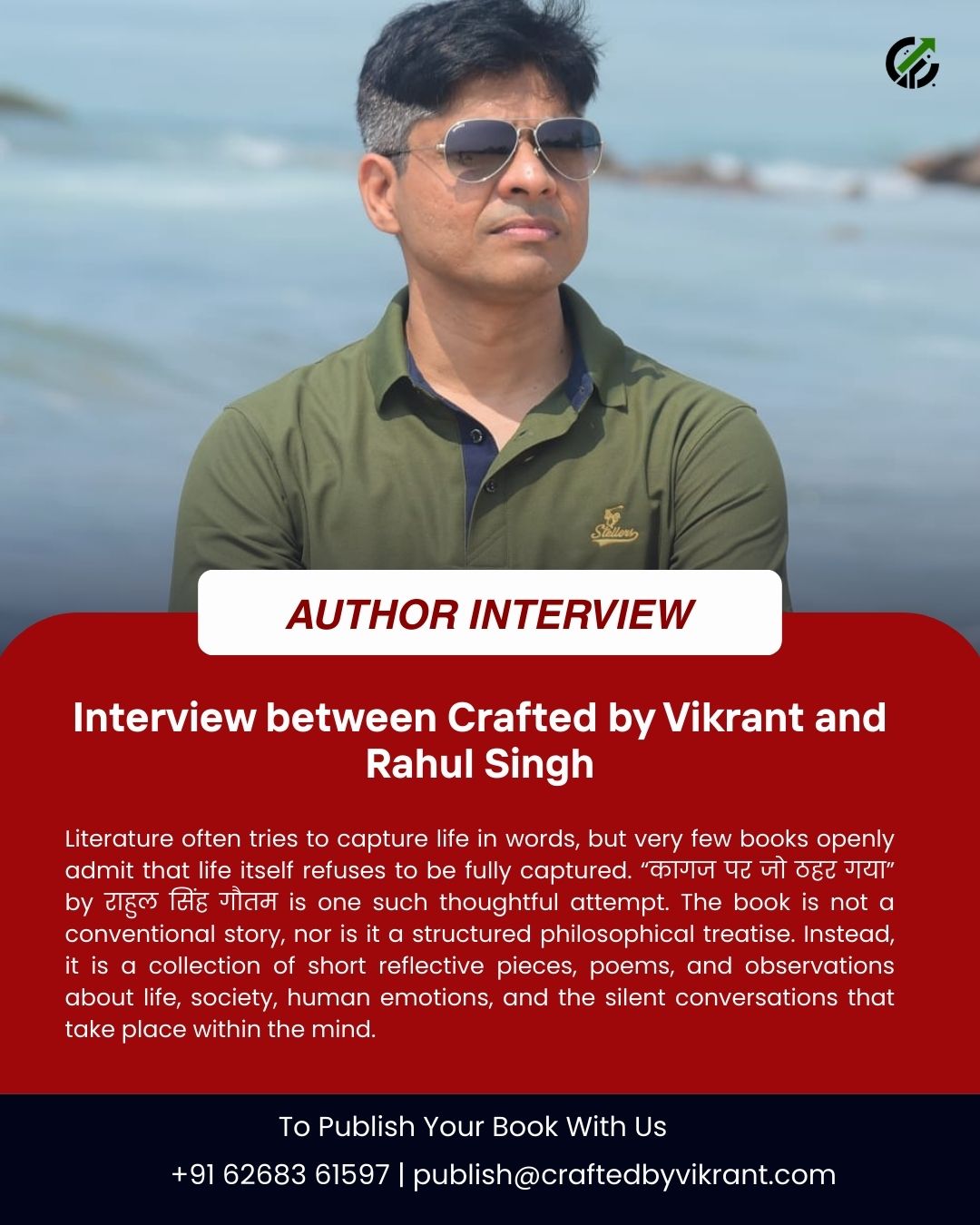
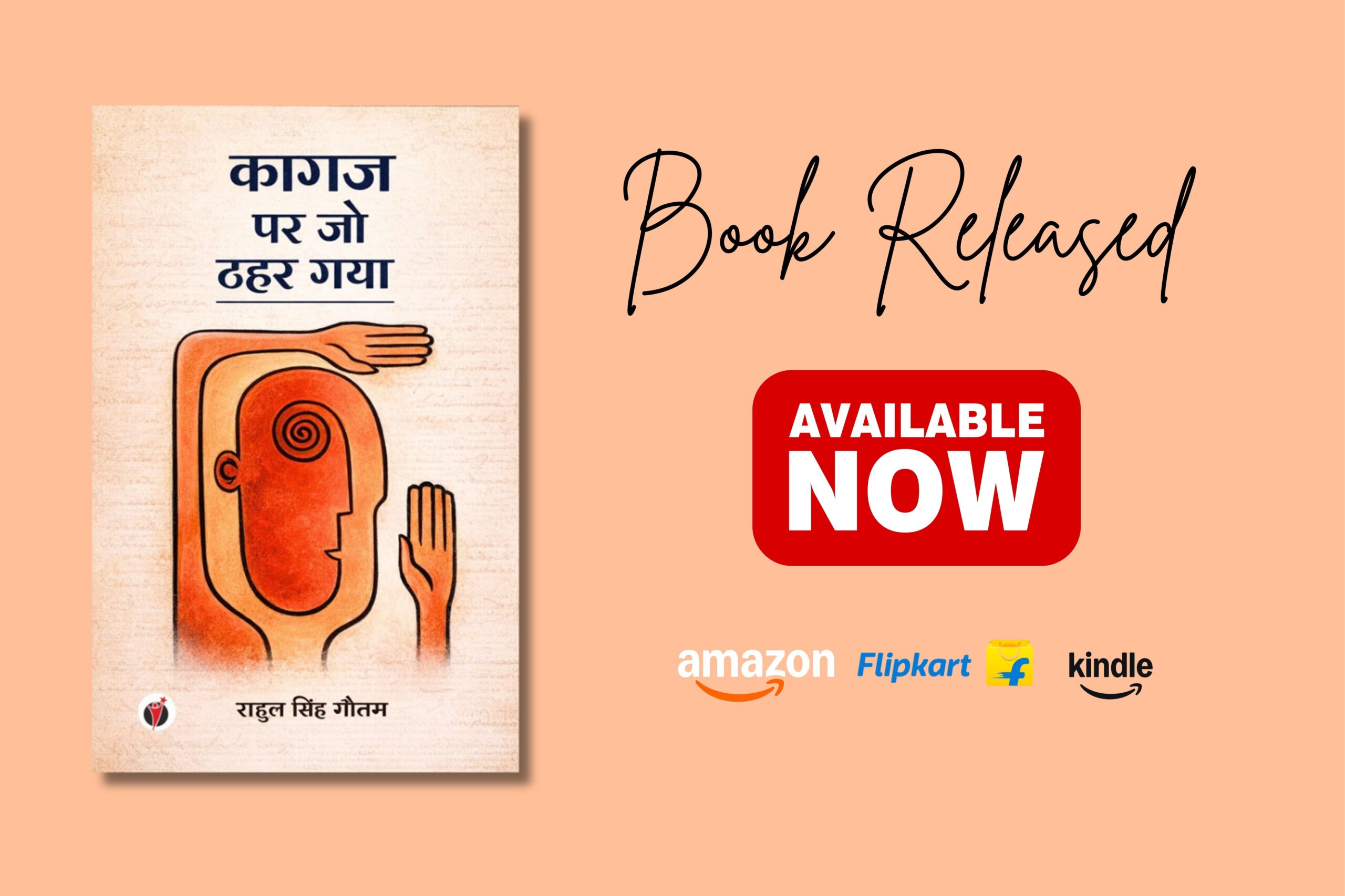
Literature often tries to capture life in words, but very few books openly admit that life itself refuses to be fully captured. “कागज पर जो ठहर गया” by राहुल सिंह गौतम is one such thoughtful attempt. The book is not a conventional story, nor is it a structured philosophical treatise. Instead, it is a collection of short reflective pieces, poems, and observations about life, society, human emotions, and the silent conversations that take place within the mind.
The title itself is deeply symbolic. It suggests that life is constantly flowing like a river, and only a few moments, thoughts, or emotions manage to pause long enough to be written on paper. In the preface, the author clearly mentions that the book does not claim to present final truths or conclusions. Rather, it tries to record life as it appears in passing moments. This humble beginning sets the tone for the entire work.
Style and Structure
The book consists of numerous short pieces, each focusing on a single idea or feeling. Some are just a few lines long, while others are slightly longer reflections. The structure resembles a diary of thoughts or philosophical notes rather than a traditional literary work.
This format is effective because it mirrors the way thoughts actually appear in human consciousness—brief, scattered, sometimes contradictory, and often unfinished. Each piece feels like a pause in the journey of life, inviting the reader to reflect on something simple yet meaningful.
The language used by the author is simple and accessible. There are no unnecessarily complex metaphors or heavy philosophical terms. Instead, the ideas are presented through everyday experiences and familiar imagery. This simplicity allows readers from different backgrounds to connect with the text.
Themes of Life and Time
One of the most dominant themes in the book is the passage of time. The author repeatedly reflects on how time moves silently while humans remain busy with their struggles, ambitions, and emotions.
In several pieces, the writer shows how people only realize the importance of time after it has already passed. The poem “मैं” highlights this beautifully by suggesting that while time keeps moving forward quietly, a person often realizes too late that their own time has slipped away beneath their feet.
Through such reflections, the book reminds readers that life is fragile and temporary. However, the author does not present this idea in a depressing way. Instead, he uses it as a reminder to remain aware and thoughtful about how one lives.
Human Mind and Inner Conflict
Another strong theme in the book is the complexity of the human mind. Many pieces explore the constant battle between thoughts, emotions, desires, and reality.
For example, in the section discussing anger, the author describes anger as something that is not brought from outside but already exists within the mind like a sleeping volcano. It only waits for the right moment to erupt. This metaphor illustrates how emotions often lie hidden beneath the surface of everyday behavior.
Similarly, the piece about silence explains how silence sometimes enters the mind like an unwanted tenant who refuses to leave. Over time, people begin to accept that silence as part of their reality. This observation captures the quiet loneliness that many individuals experience in modern life.
Social Commentary
Although the book mainly focuses on personal reflections, it also includes subtle social criticism. The author occasionally comments on the artificial nature of modern society and the way people chase recognition, success, and validation.
In the piece titled “इंसानी दर्द,” the writer talks about how society has started categorizing and evaluating pain. Only dramatic or visible suffering receives attention, while ordinary struggles remain unnoticed. This idea reflects the growing culture of social media where emotions are often displayed for approval rather than genuine understanding.
Another interesting observation appears in the piece discussing “खामोशी की लिखावट.” Here, the author uses the metaphor of stagnant water to describe systems or environments where silence hides deeper problems. This metaphor suggests that when people stop questioning or speaking up, stagnation and decay quietly begin to grow.
Philosophy Through Simple Images
One of the strengths of the book is the author’s ability to explain philosophical ideas using everyday images. Instead of complex theories, he uses examples from nature and daily life.
For instance, the comparison between worms and snakes in the poem “केंचुली” shows how society often crushes the harmless while fearing the dangerous. This short reflection highlights the irony of human behavior.
Similarly, in another piece the author compares the character of bread (roti) with human hunger. The value of bread changes depending on whether someone is hungry or not. Through this simple example, the writer indirectly talks about how circumstances shape meaning and value in life.
These kinds of small observations appear throughout the book and give it a thoughtful, almost meditative quality.
The Power of Questions
Rather than providing answers, the book frequently raises questions. Many pieces end with open thoughts that encourage readers to think deeper.
For example, the poem about existence suggests that life itself might be an illusion similar to flowing water in a river. Even though the river looks the same every day, the water inside it constantly changes. In the same way, people believe that life remains the same, even though everything is continuously changing.
Such reflections make the reader pause and reconsider familiar ideas about identity, memory, and permanence.
Emotional Depth
Despite its philosophical tone, the book also carries emotional warmth. The author acknowledges the influence of family, experiences, and relationships in shaping one’s perspective. In the preface, he expresses gratitude to his wife, daughters, and sisters for their support and inspiration.
This personal touch makes the work feel genuine. The reader senses that the ideas presented in the book are not abstract theories but thoughts shaped by real experiences.
Strengths of the Book
One of the biggest strengths of “कागज पर जो ठहर गया” is its authenticity. The author writes honestly without trying to impress readers with complicated language or dramatic storytelling.
Another strength is the flexibility of the book. Since each piece is short, readers can open the book at any page and begin reading without needing to follow a specific order. This makes the book suitable for casual reading as well as deeper reflection.
The book also encourages slow reading. Many lines carry layered meanings that become clearer after thinking about them for a while. This quality makes the book feel like a companion for quiet moments rather than a fast-paced narrative.
Limitations
While the simplicity of the book is one of its strengths, it can also be seen as a limitation for some readers. Those who prefer detailed stories or structured arguments may find the short reflections somewhat fragmented.
Additionally, the philosophical nature of the writing may require patience. Some ideas are expressed in symbolic language, and readers may interpret them differently based on their own experiences.
However, these aspects do not necessarily reduce the value of the book. Instead, they highlight its experimental and reflective nature.
Overall Impression
Overall, “कागज पर जो ठहर गया” is a thoughtful and introspective work that invites readers to slow down and observe life more carefully. It does not try to solve life’s mysteries but encourages people to notice them.
The book reminds readers that everyday experiences—silence, memory, time, emotions, and relationships—carry deeper meanings if one takes the time to reflect on them.
In a world that constantly pushes people to move faster and consume information quickly, this book offers something different. It invites readers to pause, think, and perhaps discover their own thoughts hidden within the author’s words.
Ultimately, the book succeeds in what it promises: capturing a few moments of life that managed to pause long enough to be written on paper.